|
| |

|
| |
If you want
Mobile Friendly,
please go to our website and Southern history blog
at
www.CharlestonAthenaeumPress.com
Welcome to the truth.
| |
ISBN: 978-0-9853632-7-7
(softcover print)
ISBN: 978-0-9853632-6-0 (eBook)
|
|
Published by
Charleston Athenaeum Press
| |
-
360 pages, 6 x 9" softcover
AND fabulously crafted Kindle eBook
-
Immediate shipping of any
quantity of the print edition,
ALL signed by the
author, when
purchased on this website. ALL Specials and quantities are also
signed. Purchases on Amazon are
not signed because they are shipped directly
by Amazon.
-
WHOLESALE DISCOUNTS on 5, 10 and
25 copies for ALL heritage organizations AND individuals (scroll
down to Specials).
-
Easy to read and
thoroughly documented
with 218 footnotes
making the "conclusive case" that slavery
was not the cause of the
War Between the States.
-
Over 200 sources used, all
cataloged in a
bibliography
broken down
by primary and secondary sources.
-
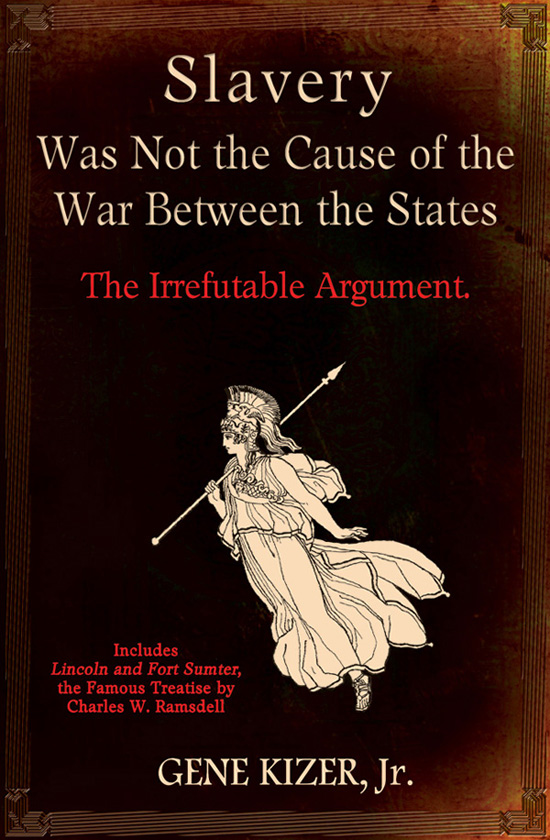
Part I, The Irrefutable
Argument, makes the “conclusive” case that the North did not
go to war to free the slaves or end slavery. They went to war
because they faced economic annihilation of their own doing, and
war was their only way out.
-
Part II is The Right of
Secession, documenting and proving that
States had the right to secede from the Union (e.g., Virginia,
New York and Rhode Island specifically reserved the right of
secession
before acceding to the U.S. Constitution, thus giving that right to
all the States;
MUCH more solid proof provided).
-
Part III is the famous treatise
Lincoln and Fort Sumter
by Charles W. Ramsdell proving with fascinating scholarly detail
that
Lincoln deliberately started the war in Charleston Harbor
to
prevent
the economic collapse of the North, which was well
underway.
-
Includes "An Annotated Chronology
of the Secession Debate
in the South,"
a day-by-day account of
speeches, convention dates,
ratification
votes,
birth of the Confederate States of America, beginning
of the war, and
secession of the final Southern States.
-
Includes a powerful
"Introduction" full of history to
kick off the argument,
and "Author's Final Assessment" to
conclude it.
-
Includes a section devoted to further study:
"Additional Resources
for the
Study of Southern History and
Literature."
-
Individual orders shipped USPS
Priority 2-3 day shipping
-
Email notification when your
order has shipped
-
Author bio
(Click Here)
-
Kindle eBook is available on
Amazon and is NOT a standard print-to-eBook conversion but
was formatted and crafted by the author to be a GREAT reading
experience. All 218 notes are included with bibliography.
EVERYTHING that is in the print version is in the eBook.
You can give it as a GIFT with the click of a mouse.
Click Here to see eBook sample pages on Amazon and to
buy.
-
Scroll down for 86 sample pages
from the print edition, and to buy signed copies.
|
|
| |
Historians used to know - and it was not too long ago - that the War
Between the States had more to do with economics than it did with
slavery. The current obsession with slavery as the "cause" of the war
rests not on evidence but on ideological considerations of the present
day. Gene Kizer has provided us with the conclusive case that the
invasion of the Southern States by Lincoln and his party (a minority
of the American people) was due to an agenda of economic domination
and not to some benevolent concern for slaves. This book is rich in
evidence and telling quotations and ought to be on every Southern
bookshelf.
Clyde N. Wilson
Emeritus Distinguished Professor of History
University of South Carolina
Gene Kizer persuasively shows how the North fought the South out of
necessity to prevent economic collapse. No where else is proof of this
motive made clearer with indisputable evidence. Mr. Kizer writes with
authority from the desire to tell the truth. His common sense style is
the product of honesty. One cannot read his work without concluding
that this is a man to be trusted.
James Everett Kibler
Critically acclaimed novelist, poet,
historian, and literary scholar
Author of
Our Fathers' Fields; Walking Toward Home;
and many other outstanding books.
|
|
$21.95
(plus shipping)
All U.S. orders are shipped
USPS
Priority Mail
with expected 2-3 day delivery
Click Here
for info. on International orders
To mail a check,
Click
Here for information
CLICK HERE for 86 sample
pages from
Slavery Was Not the Cause of the
War Between the States,
The Irrefutable Argument.
Scroll down for several free PDF articles and
moneysaving
Specials
A two-DVD set
The most brilliant talk on black Confederates
ever given,
featuring distinguished professor
Edward C. Smith
Scroll down for DVD Special
and
a ten minute video
clip

| |
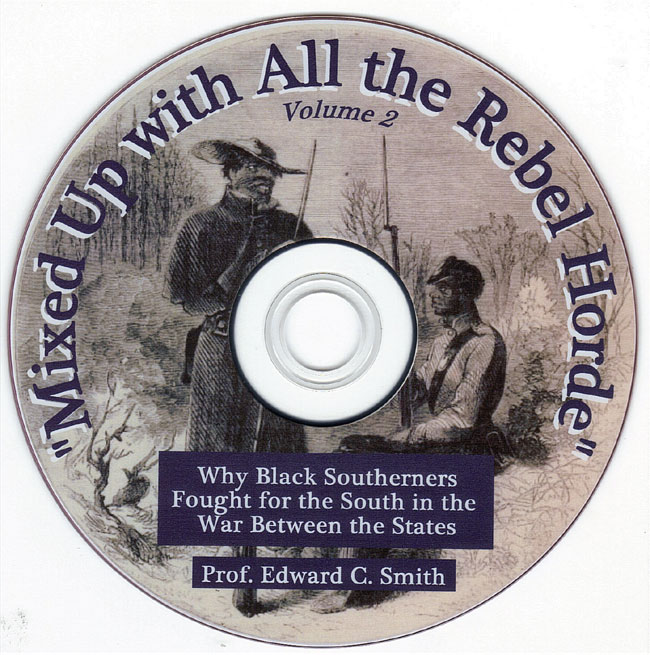
On DVD labels are actual
black Confederates as seen by a Yankee officer through his field-glass.
The drawing was published in
Harper's Weekly, January 10, 1863
with title "Rebel Negro Pickets as Seen Through a Field Glass."
|
|
| |
Professor
Edward C. Smith is one of the foremost authorities in America on
black Confederates
and the participation of blacks on the Southern side in
the War Between the States. He is a professor of Anthropology at
American University where he has taught since 1969, and the founder &
co-director of the American University Civil War Institute.
He is
also a Civil War, African-American Cultural
Heritage,
Art History Lecturer and Study Tour Leader for
The Smithsonian
Institution, The National Geographic Society,
The National Park Service
and The Historical Society of Washington, D.C.
In this Two-DVD talk that
totals over 70 minutes,
Professor Smith speaks to an enthusiastic crowd of the
Sons of Confederate Veterans at their national convention
August 12,
1993 in Lexington, Kentucky.
Not only is Professor Smith
fascinating and articulate, he is witty and broke the crowd up
continuously with laughter and applause. He received a THUNDEROUS standing
ovation at the end.
You will rave
about this talk!
(Click here for more information)
|
|
Cataloged in Books in Print
| |
ISBN: 0-9818980-9-2
ISBN13: 978-0-9818980-9-4
|
Published by
Charleston Athenaeum Press
To Purchase
A single set consists of both DVDs,
Volumes 1 and 2.
One DVD Set at $24.95
Total is $24.95 plus shipping
DVD SPECIAL
Buy One Set & Get the Second Set for Only $10.
That's Four DVDs for $34.95 plus
shipping
Three DVD Sets at $21.95 ea. (12%
Discount)
Total is $65.85 plus shipping
Please send me an e-mail for greater DVD quantities or any other question
BonnieBlueStaff@comcast.net
Specials
Buy in quantity as fundraisers, give
as gifts to friends and the historically challenged,
donate to schools and libraries!
| |
-
Free
PDF Download of the 30-page
essay,
Historians of the Past Tower Over the PC Frauds
of Today, by Gene Kizer, Jr. This essay is
loaded with fire and fact, excoriating and laughing at
the PC frauds in academia, the news media and the
Democrat Party, which are one and the same. It shows
clearly why historians of the past are so much better
than many - perhaps most - historians today.
-
Free PDF Download of
the six page article,
We Are in a Political Fight and Not a History Debate,
by Gene Kizer, Jr., Confederate Veteran
magazine, May-June, 2018.
-
Free PDF Download of
the six page article,
The Absurdity of Slavery as the Cause of the War
Between the States,
by Gene Kizer, Jr., Confederate Veteran
magazine, March-April, 2017.
-
Free PDF Download of a POWERFUL 943
word article sent to the editor of the Post and
Courier (Charleston, SC) 9-15-18 obliterating a
letter-writer's assertions that the crew of the
Confederate submarine CSS Hunley were traitors.
-
Free PDF Download
of a comprehensive six page article entitled The
Secession of South Carolina, Mississippi, Florida,
Alabama, Georgia, Louisiana and Texas, and the
Creation of the Confederate States of America,
by Gene Kizer, Jr.
-
Free PDF Download
of Virginia First, by Dr. Lyon Gardiner
Tyler, son of our 10th United States president, John
Tyler, who was president from 1841 to 1845, and a
member of the Confederate Congress. Lyon
Gardiner Tyler is also author of A Confederate
Catechism and numerous other books and articles.
He was the 17th president of the College of William
and Mary and its savior after the
War Between the States. He had a brilliant career as
president of William and Mary and served for over
three decades, from 1888 to 1919. Virginia First
establishes clearly that America was founded in the
South, at Jamestown, Virginia, in 1607, and not in New
England as is erroneously stated at times.
-
Free PDF Download
of Texas v. Pennsylvania, Georgia, Michigan, and
Wisconsin, in the Supreme Court of the United States,
December 7, 2020.
-
Click Here for a Special that includes Slavery Was Not the Cause of the War Between the
States, The Irrefutable Argument. AND the Two-DVD Set on black Confederates,
Mixed Up with All
the Rebel Horde, Why Black Southerners Fought for the South in the
War Between
the States, featuring
Professor Edward C. Smith (scroll up or down to purchase separately or see a 10 minute video clip).
Save $10.
-
Click Here for a
Special that includes THREE COPIES
of
Slavery Was Not the Cause of the War Between the States, The Irrefutable
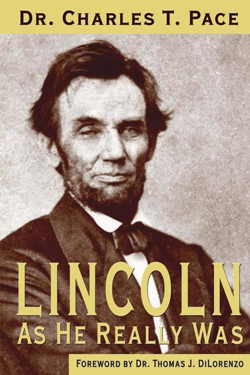
Argument. PLUS a 50% discount off Shotwell Publishing's excellent book Lincoln as He Really
Was by Dr. Charles T. Pace, PLUS FREE, one Two-DVD Set
Mixed Up with All the Rebel Horde, Why Black Southerners Fought for the South in
the War Between the States featuring Professor Edward C. Smith (scroll up or down
for video).
Save $34.95.
-
Click Here for a Special that includes THREE COPIES
of
Slavery Was Not the Cause of the War Between the States, The Irrefutable
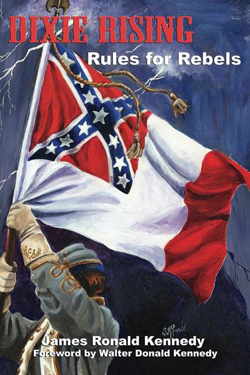
Argument. PLUS a discount on Shotwell Publishing's excellent book Dixie
Rising by
Ron Kennedy (with Foreword by his brother, Donnie Kennedy, who is SCV Chief of
Heritage Operations) PLUS FREE, one Two-DVD Set
Mixed Up with All the Rebel Horde, Why Black Southerners Fought for the South in
the War Between the States featuring Professor Edward C. Smith (scroll up or down
for video).
Save $34.95.
-
Click Here and get FIVE BOOKS for $99
(a 10% discount)
PLUS the Two-DVD Set on black Confederates FREE:
Get five copies
of
Slavery Was Not the Cause of the War Between the States, The Irrefutable
Argument. PLUS one of the Two-DVD Set
Mixed Up with All the Rebel Horde, Why Black Southerners Fought for the South in
the War Between the States featuring
Professor Edward C. Smith FREE (scroll up or down for a video).
-
Click Here for Quantity Book Discounts
(10 and 25 copies)
on Slavery Was Not the Cause of the War
Between the States, The Irrefutable Argument. Individuals can also purchase
with quantity discounts. All quantity orders get a FREE copy of Dr. Clyde N.
Wilson's excellent book, The Old South: 50 Essential Books.
-
Click Here for a TRIPLE
SPECIAL and SAVE
$21.95. Get:
| |
-
Slavery Was Not the Cause of the War Between the
States,
The Irrefutable Argument.
-
Charles W. Ramsdell, Dean of Southern
Historians,
Volume One: His Best Work (scroll down for info on this book)
-
The two-DVD set featuring Professor Edward
C. Smith:
Mixed Up with All the Rebel Horde, Why
Black Southerners
Fought for the South in the War Between the States.
|
Get all these for $48.90 (reg. price $70.85) plus shipping.
|
|
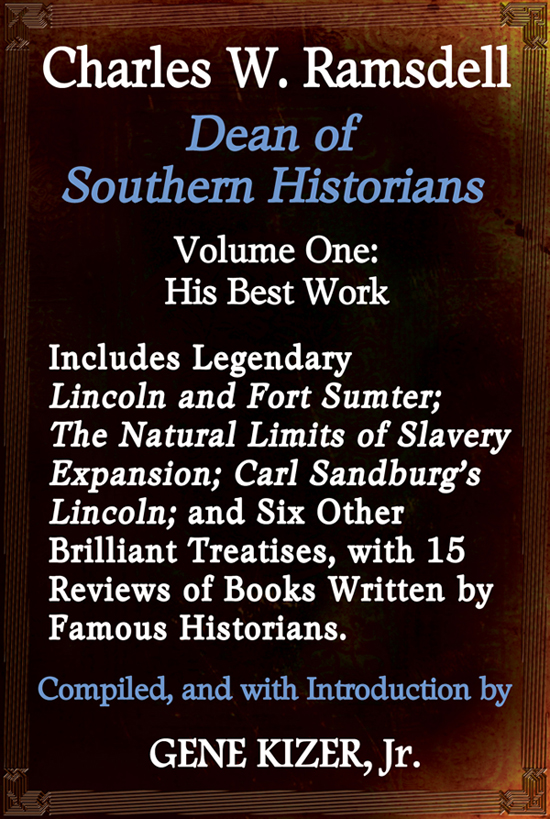
"Lincoln and Fort Sumter"
and other brilliant writings of
Charles W. Ramsdell
"In all that pertained to
the history of the Southern Confederacy,
his scholarship was decisive."
In Memoriam
Charles William Ramsdell
University of Texas
ISBN: 978-0-9853632-3-9
I M M E D
I A T E S H I P P I N G !
462 Pages
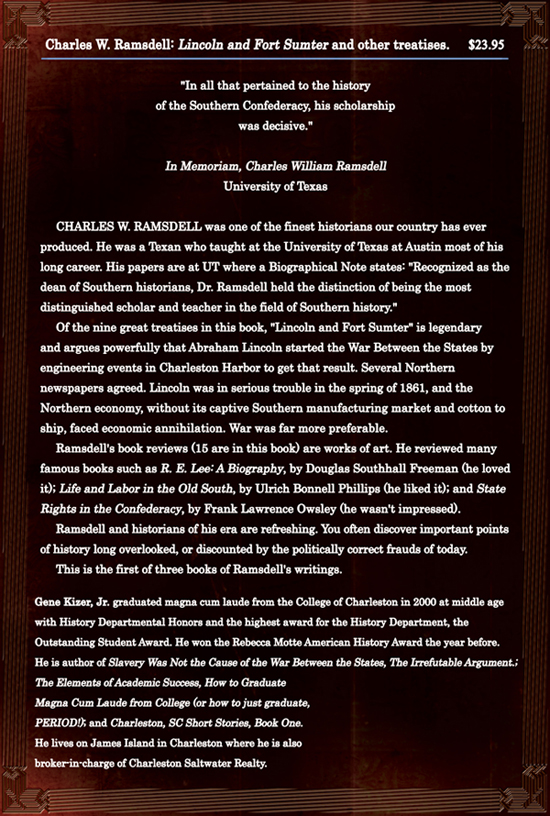
Contents
|
| |
| |
Ramsdell's Famous Treatises
-
Lincoln and Fort
Sumter
-
The Natural
Limits of Slavery Expansion
-
The Changing
Interpretations of the Civil War
-
Some Problems
Involved in Writing the History of the Confederacy
-
Carl Sandburg's
Lincoln
-
The Southern
Heritage
More Treatises: Ramsdell's In-Depth Analyses of Challenges Behind
Confederate Lines
that Greatly Affected the War
-
General Robert E.
Lee's Horse Supply, 1862-1865
-
The Confederate
Government and the Railroads
-
The Control of
Manufacturing by the Confederate Government
Ramsdell's Book Reviews Are Works
of Art
|
| |
(Compiler's Note: There is an unbelievable
amount of history in each of the fifteen book reviews in this section.
Ramsdell had to include a lot in order to provide background and put the subject in perspective. Ramsdell pulls no punches. He reviewed way
more than fifteen books in his career but in this fifteen are
outstanding, well-known books by distinguished historians.)
|
|
| |
-
R. E. Lee: A
Biography, 4 vols., by Douglas Southall Freeman
-
The Civil War
and Reconstruction, by J. G. Randall
-
The
Repressible Conflict, 1830―1861,
by Avery Craven
-
The American
Civil War: An Interpretation, by Carl Russell
Fish
-
State Rights
in the Confederacy, by Frank Lawrence Owsley
-
Life and Labor
in the Old South, by Ulrich Bonnell Phillips
-
The Story of
the Confederacy, by Robert Selph Henry
-
Constitutional
Problems under Lincoln, by James G. Randall
-
Guide to the
Study and Reading of American History, by Edward
Channing,
Albert Bushnell Hart, and Frederick J. Turner
-
Bedford
Forrest, The Confederacy's Greatest Cavalryman,
by Eric William Sheppard
-
Southern
Editorials on Secession, compiled by Dwight
Lowell Dumond
-
The Secession
Movement, 1860―1861,
by Dwight Lowell Dumond
-
Aeronautics in the Union and
Confederate Armies, With a Survey
of Military Aeronautics Prior to 1861, Vol. I, by F. Stansbury Haydon
-
Lincoln Takes
Command, by John Shipley Tilley
-
John Brown, Soldier of
Fortune: A Critique, by Hill Publes Wilson
Bibliography of the Writings of Charles W. Ramsdell
|
|
| |
$23.95 plus USPS Priority shipping
(scroll up and look under
Specials for quantity discounts
on 5, 10 and 25 books)
Scroll up to Specials for a
TRIPLE SPECIAL that includes this book
AND
Slavery Was Not the Cause of the War Between the States,
The Irrefutable Argument.
AND
The two-DVD set:
Mixed Up with All the Rebel Horde,
Why Black Southerners Fought for the South in the
War Between the States.
(scroll up or down for video clip)
Save $21.95
Pro-South and NOT politically correct!
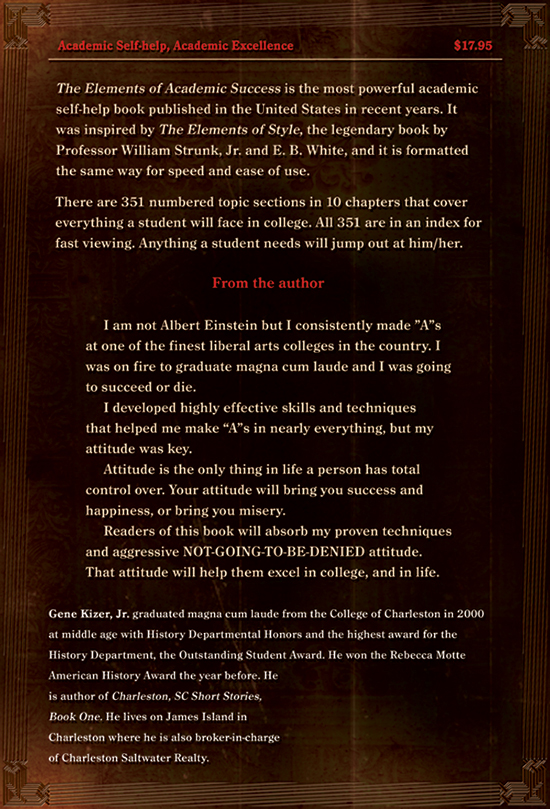
The most powerful academic guide since
Strunk and White's classic, The
Elements of Style,
for high school, college and adult
students.
by Gene Kizer, Jr.
 |
| |
|
| |
Published by Charleston Athenaeum Press |
| |
-
364 page softcover
(6 x 9")
with 351 numbered topic sections in 10 chapters that are EASY to go through
-
First print edition, signed by
the author
-
Highly
beneficial to high school and college students as well as adults
returning to school
-
Scroll down to read sections that
include Southern History and the first few pages of each of the 10
chapters
-
Readers will absorb the author's highly effective
skills, techniques and NOT-GOING-TO-BE-DENIED attitude
-
Purchase and
give to libraries and students in need
-
Click Here for ebook on Amazon, which you can give as a gift
|
|
| |
 |
| |
Gene Kizer was just the kind of
college student that professors love
– a mature one who knows what he is
doing. He understands the workings of today's higher education well and
gives you chapter and verse on how to succeed in it. But his guide can
lead you to something even better and rarer. By following it you stand a
good chance of getting a real education.
Clyde N. Wilson
Emeritus Distinguished Professor
University of South Carolina
Columbia, South Carolina
You've published
a helpful, practical guide to academic success for
Southern youths who refuse to be placed on the guilt train
"liberal" education has in store for them.
James Everett Kibler
Critically acclaimed novelist, poet,
historian, and literary scholar
Author of
Our Fathers' Fields; Walking Toward Home;
and many other outstanding books.
|
|
(Click below to view the first few pages
of each chapter)
Click Here for sections that include Southern
history such as
| |
259. Southern history as it is taught today is a "cultural and
political atrocity," and students are being CHEATED.
Esteemed historian, Eugene D. Genovese, who passed away September 26,
2012, was disgusted with the way Southern history is taught today. He
writes:
To speak positively about any part of this Southern
tradition is to invite charges of being a racist and an apologist for
slavery and segregation.
We are witnessing a cultural and
political atrocity -
an increasingly successful
campaign by the media and an academic elite to strip young white
Southerners, and arguably black Southerners as well, of their
heritage, and therefore, their identity. . . .
|
|
Click below
The first 21
pages
including Contents
and Author's Note
I
Start Strong
Be Organized and in Control
II
Professors
III
Class
IV
Grades
V
Studying Effectively
VI
Preparing for Tests/Exams
VII
Taking Tests/Exams
VIII
Papers and Writing
IX
Presentations
X
Continue Strong
Winning, and the Philosophy of Success

(You do not need a PayPal account
to pay by credit card below)
$19.95
(plus shipping added at
checkout;
SC residents add
8.5% sales tax)
Please LINK to us,
and
join
our e-mail list for New
Publications and Specials!
Fiction set
in Charleston, South Carolina!
A
Fabulous Kindle Ebook
with 31 Pictures of
Charleston
by Gene Kizer, Jr.
(click front cover, below, to go to Amazon
and read some of it, or buy at $2.99; you
can also give it as a gift)
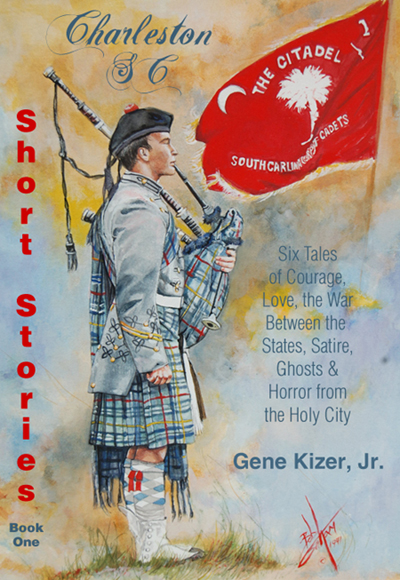
ISBN: 978-0-9853632-0-8
There are pictures in this book of all the places where action,
fights, war,
murder and love took place.
Additional
information and an excerpt
at
www.CharlestonAthenaeumPress.com
Below are 24
Outstanding DVDs
on Southern
History and Literature
from The History &
Literature of the South DVD Series.
Individual DVDs are $7.95 but in sets, they are less.
Six DVD Set
Secession,
The War Between the States,
Reconstruction
Featuring distinguished historians:
Dr. Clyde N. Wilson
Dr.
Donald Livingston
Joseph
Stromberg
Scroll
down for bios

You don't have to have a PayPal account
to pay by credit card through PayPal.
1 hour, 13 minutes
$7.95 plus shipping; scroll down to
buy set
| |
All DVDs on this website come in clear jewel cases to show off their beautiful historical art
work. Shipping is added at checkout. These are PERFECT sets to give to
the historically-challenged, to play as the featured program at camp,
chapter and other historical organization meetings, and to donate to libraries and schools.
|
|
1 hour, 18 minutes
$7.95 plus shipping; scroll down to
buy set
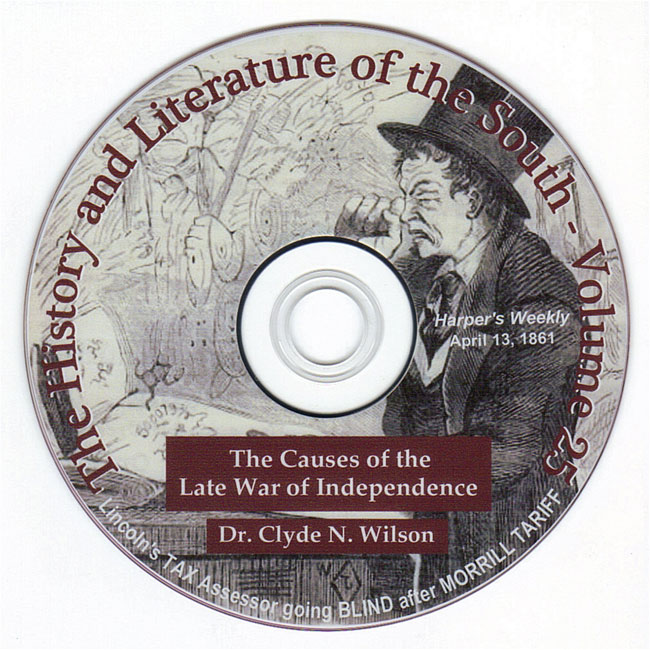
1 hour, 18 minutes
$7.95 plus shipping; scroll down to
buy set
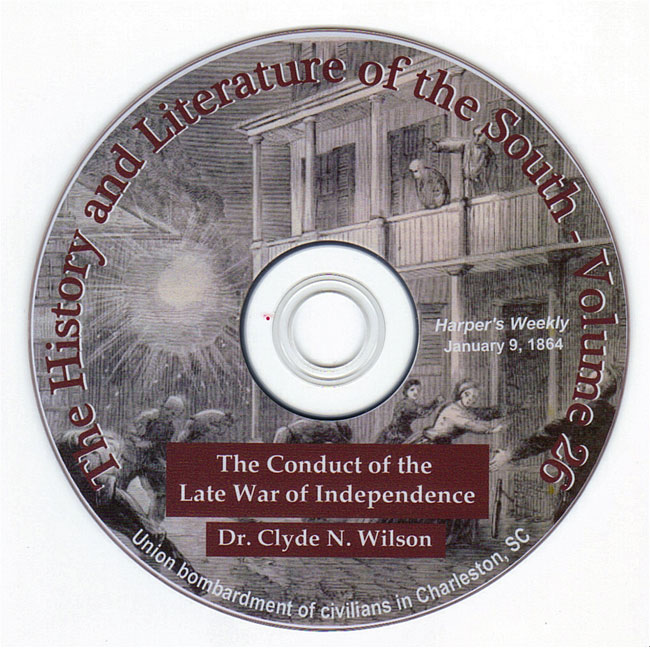
1 hour, 6 minutes
$7.95 plus shipping; scroll down to
buy set
1 hour, 17 minutes
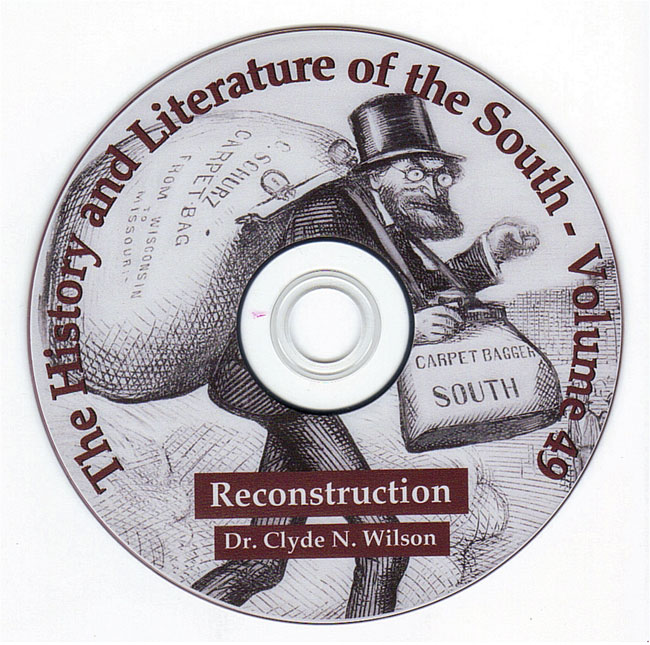
$7.95 plus shipping; scroll down to
buy set
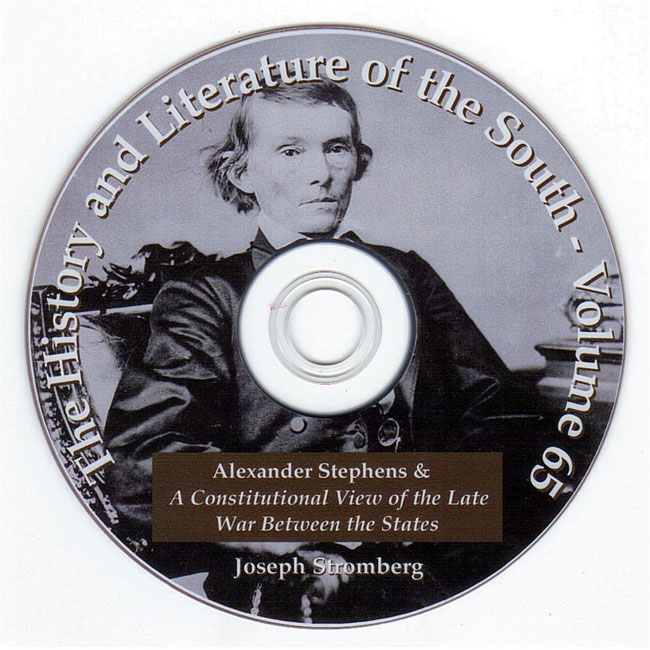
1 hour, 14 minutes
$7.95 plus shipping; scroll down to
buy set
To
purchase the set
(all six DVDs at
10% off the
normal price)
$42.93
plus shipping
If you'd rather mail a check:
Please add $7.50 shipping/handling and make it payable
to Gene Kizer and mail to:
| |
Gene Kizer, Jr., Producer
Bonnie Blue Publishing
P.O. Box 13012
Charleston, SC 29422-3012
|
|
Dr. Clyde N. Wilson
Bio
Dr. Donald Livingston
Bio
| |
Donald W. Livingston is
Distinguished Professor Emeritus of Philosophy at
Emory
University in Atlanta, renowned for his expertise on one of
the most important figures in the history of
Western Philosophy, the
Scottish philosopher, historian, economist and essayist,
David
Hume.
Professor Livingston has been a National
Endowment for the Humanities fellow, and is a member of the
editorial board of
Hume Studies, as well as
Chronicles
magazine. He is author of Hume's
Philosophy of Common Life,
and
Philosophical
Melancholy and Delirium,
and
co-editor or
contributor to numerous other works.
Professor Livingston is also well thought of as a constitutional
scholar with numerous writings on the
Compact Theory,
Nullification,
Secession,
Federalism,
States'
Rights and
Subsidiarity, with a common theme of
Decentralization. He believes
strongly in the philosophies of
Thomas Jefferson,
Robert Hayne and
John C. Calhoun, as opposed to the centralizing philosophies of
Joseph Story,
Daniel Webster and
Abraham Lincoln.
Professor Livingston characterizes Lincoln's
farcical position -- that the Union created the states as opposed
to the other way around -- as "Lincoln's Spectacular Lie."
Professor Livingston is also one of the
founding members of the
Abbeville Institute, which is "an
association of scholars in higher education devoted to a critical
study of what is true and valuable in the Southern tradition." He
is currently working on a book "on the moral, legal, and
philosophical meaning of secession."
|
|
Joseph R. Stromberg
Mises Institute
Bio
| |
Joseph R. Stromberg holds the JoAnn B. Rothbard
chair in history at the Ludwig von Mises Institute in
Auburn, Alabama, and is historian-in-residence there. He lectures
frequently on various topics in Southern history including the
constitutionality of secession, as well as economic issues.
|
|
Five DVD Set
The War Between the States
and Reconstruction
A
comprehensive, scholarly treatment of the War Between the States
and Reconstruction in a beautiful five-DVD set
featuring
one
of the
finest historians alive today
Dr. Clyde N. Wilson
1 hour, 16 minutes
$7.95 plus shipping; scroll down to
buy set
1 hour, 17 minutes
$7.95 plus shipping; scroll down to
buy set
1 hour, 18 minutes
$7.95 plus shipping; scroll down to
buy set
1 hour, 6 minutes
$7.95 plus shipping; scroll down to
buy set
1 hour, 17 minutes
$7.95 plus shipping; scroll down to
buy set
To purchase the set (all five
DVDs)
$34.95 plus shipping
If you'd rather mail a check:
Please add shipping and make it payable
to Gene Kizer and mail to:
| |
Gene Kizer, Jr., Producer
Bonnie Blue Publishing
P.O. Box 13012
Charleston, SC 29422-3012
|
If you have any questions, please e-mail us:
A two-DVD set
The most brilliant talk on black Confederates
ever given,
featuring distinguished professor
Edward C. Smith
Scroll down for DVD Special
and
a ten minute video
clip
| |
On DVD labels are actual
black Confederates as seen by a Yankee officer through his field-glass.
The drawing was published in
Harper's Weekly, January 10, 1863
with title "Rebel Negro Pickets as Seen Through a Field Glass."
|
|
| |
Professor
Edward C. Smith is one of the foremost authorities in America on
black Confederates
and the participation of blacks on the Southern side in
the War Between the States. He is a professor of Anthropology at
American University where he has taught since 1969, and the founder &
co-director of the American University Civil War Institute.
He is
also a Civil War, African-American Cultural
Heritage,
Art History Lecturer and Study Tour Leader for
The Smithsonian
Institution, The National Geographic Society,
The National Park Service
and The Historical Society of Washington, D.C.
In this Two-DVD talk that
totals over 70 minutes,
Professor Smith speaks to an enthusiastic crowd of the
Sons of Confederate Veterans at their national convention
August 12,
1993 in Lexington, Kentucky.
Not only is Professor Smith
fascinating and articulate, he is witty and broke the crowd up
continuously with laughter and applause. He received a THUNDEROUS standing
ovation at the end.
You will rave
about this talk!
(Click here for more information)
|
|
Cataloged in Books in Print
| |
ISBN: 0-9818980-9-2
ISBN13: 978-0-9818980-9-4
|
Published by
Charleston Athenaeum Press
To Purchase
A single set consists of both DVDs,
Volumes 1 & 2.
One DVD Set at $24.95
Total is $24.95 plus shipping
DVD SPECIAL
Buy One Set & Get the Second Set for Only $10.
That's Four DVDs for $34.95 plus
shipping
Three DVD Sets at $21.95 ea. (12%
Discount)
Total is $65.85 plus shipping
Please send me an e-mail for greater DVD quantities or other questions
BonnieBlueStaff@comcast.net
A
three-DVD set
More from Dr. Clyde
Wilson,
editor of
The Papers of
John C. Calhoun
John C. Calhoun
John C. Calhoun:
Last of the Founding Fathers
&
John C. Calhoun:
Prophet
&
John C. Calhoun:
Seminar, Part 1
1 hour, 19 minutes
$7.95 plus shipping; scroll down to
buy set
1 hour, 18 minutes
$7.95 plus shipping; scroll down to
buy set
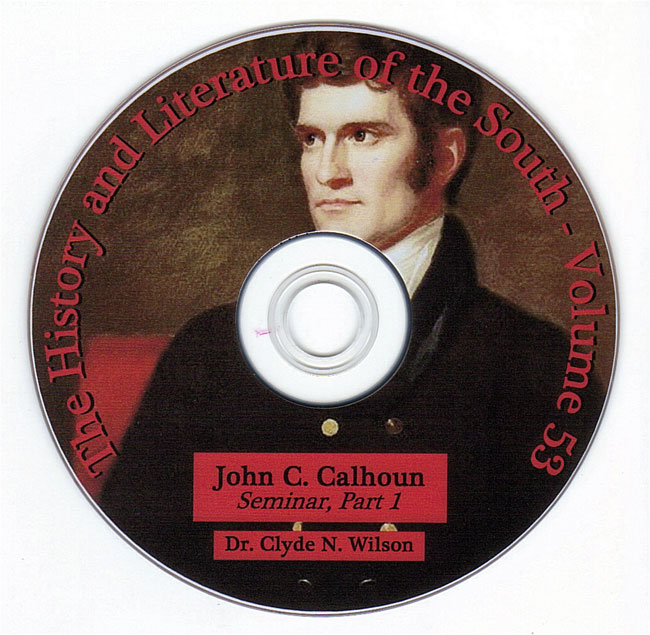
1 hour, 19 minutes
$7.95 plus shipping; scroll down to
buy set
To purchase the set (all three
DVDs)
$21.95 plus shipping
A two-DVD set
A Live WORLD CLASS Concert
of Antebellum Southern Music featuring
two magnificent singers and a pianist!
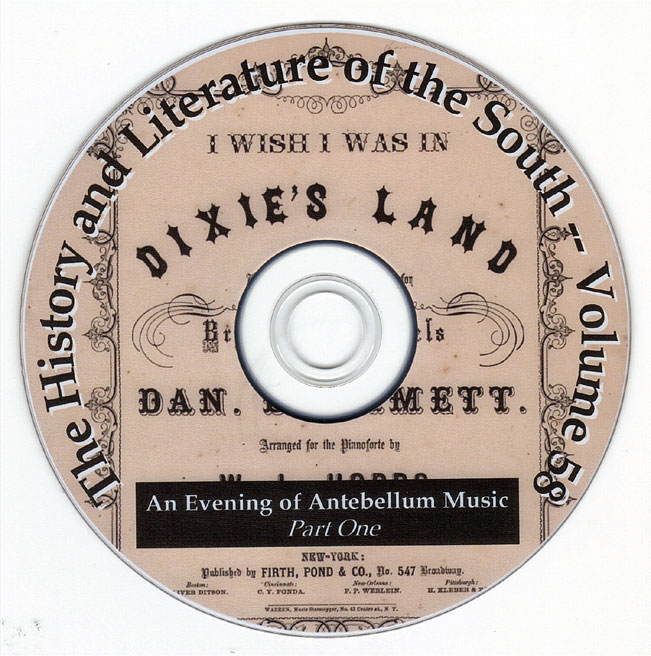
55 minutes
$7.95 plus shipping;
scroll down to
buy set
| |
On this DVD they
perform The Southron's Chaunt of Defiance, Lorena, Maryland, My
Maryland!, Bonnie Blue Flag and The Homespun Dress, Southern Soldier
Boy, Here's Your Mule, Goober Peas, God Save the South,
The South Shall Rise Up Free!, Somebody's Darling, and The
South. There is fascinating historical commentary before each
song.
|
|
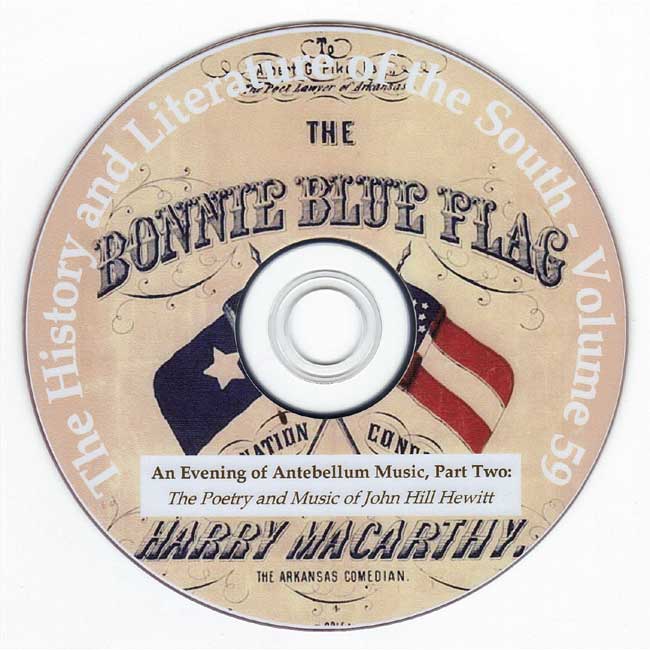
49 minutes
$7.95 plus shipping; scroll down to
buy set
| |
Part Two begins where Part One ends, starting with the
intermission music, two great piano pieces entitled The Jefferson
Davis Grand March and The Stonewall Quick Step, then an
enlightening short talk on legendary Southern composer and songwriter,
John Hill
Hewitt, THEN All Quiet Along the Potomac, You Are Going To the
War Willie Boy!, The South Shall Rise Up Free!, The Young Volunteer,
The Volunteer, Somebody's Darling, The South, and ending with a
long, rousing version of Dixie! |
|
To purchase the set (two
DVDs)
$14.95 plus shipping
A five-DVD set
Literary DVDs on
five brilliant writers from Georgia
and some of their works
| |
-
Flannery O'Connor
-
Margaret Mitchell &
Gone with the Wind
-
Augustus B. Longstreet &
Georgia Scenes
-
Sidney Lanier
-
Joel Chandler Harris &
Uncle Remus
|

1 hour, 21 minutes
$7.95 plus shipping; scroll down to
buy set
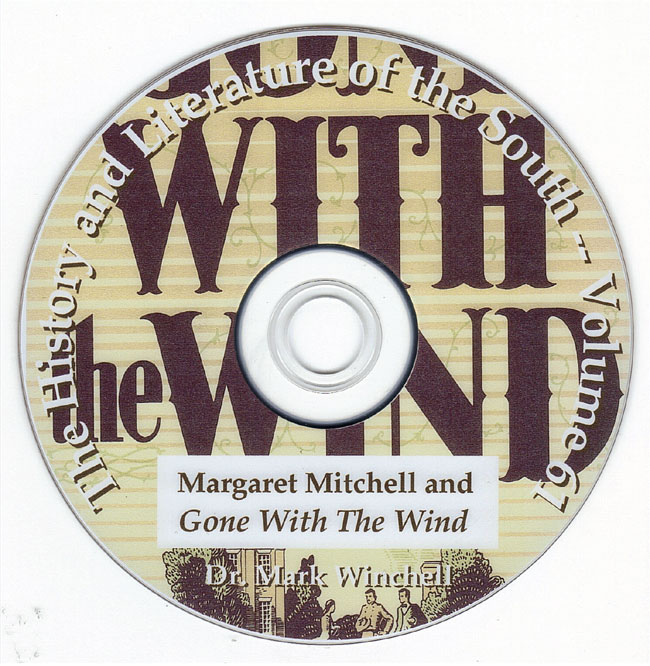
1 hour, 21 minutes
$7.95 plus shipping; scroll down to
buy set
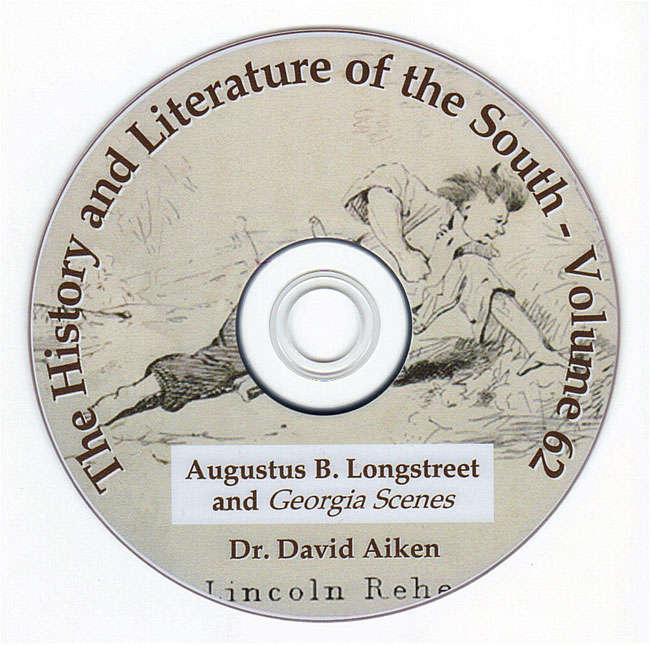
1 hour, 22 minutes
$7.95 plus shipping; scroll down to
buy set
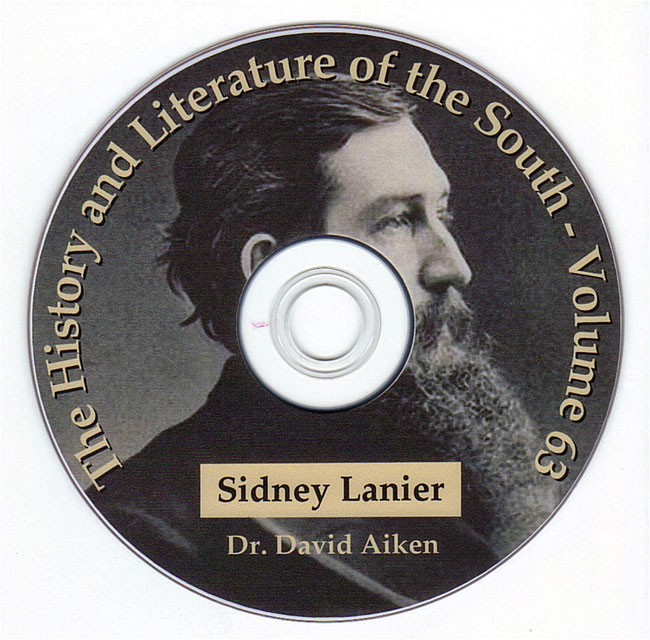
1 hour, 21 minutes
$7.95 plus shipping; scroll down to
buy set
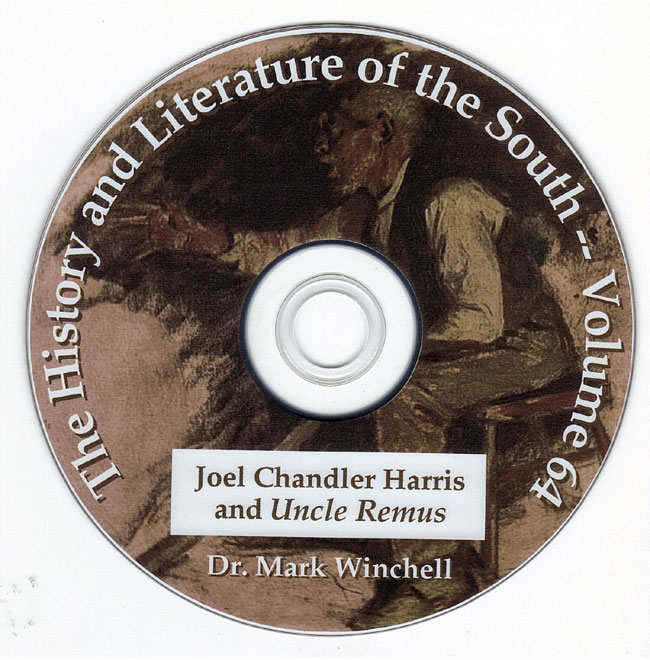
1 hour, 13 minutes
$7.95 plus shipping; scroll down to
buy set
| |
This is one of the most enjoyable and
enlightening sets you will ever view on Southern literature
featuring five prominent Georgia writers and some excellent
speakers.
Mary Barbara Tate, talking about her good
friend, Flannery O'Connor, is charming, witty and articulate. She
knew O'Connor well and spent many hours with her at her home,
Andalusia, in
Milledgeville, Georgia. You can't help but love Mrs. Tate.
She knows more about
Flannery
O'Connor than almost anybody and from the familiarity of a good
friend.
from
Literary Traveler . . .
Mary Barbara Tate, a member of the
Flannery O'Connor-Andalusia Foundation
board
of directors, fondly remembers her visits to Andalusia during
O'Connor's time there. A professor of English at
Georgia College & State University for twenty-three years, Tate belonged to a reading group that
met every week at the farmhouse to discuss Southern literature chosen by
O'Connor.
Dr. Mark Winchell, before he passed away, was a
prominent literary scholar and English professor at Clemson University. He loved
the Nashville Agrarians, historically accurate portrayals of Southern
history in film such as Gods and Generals and
Ride with the
Devil, and he knew a LOT about the greatest novel ever written:
Gone with the Wind.
Gone with the Wind has broken more records,
worldwide, than
almost any other piece of literature. It was banned by the Nazis in World
War II because they hated literature that portrayed a conquered people
rising back up.
Dr. Winchell's talk on
Joel Chandler Harris and
Uncle Remus is outstanding also. It, too, mixes literature with film,
which always had a great attraction for Dr. Winchell. His love of
subject is reflected
in his talk.
Dr. David Aiken, another excellent, knowledgeable
speaker and author, is a literary scholar and professor of
English at The Citadel and the
College of Charleston, South Carolina. He gives fascinating
talks on
Augustus Baldwin Longstreet and
Georgia Scenes, and
Sidney
Lanier.
|
|
To purchase the set (all five
DVDs)
$34.95 plus shipping
A six-DVD set
The Right of Secession
A Constitutional and
Philosophical View
-
Secession and the American Constitutional Tradition
by Dr. Donald Livingston
-
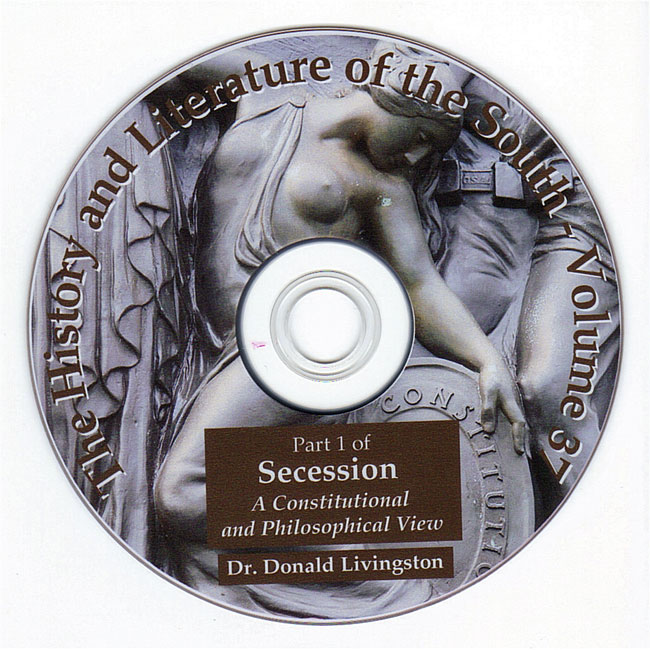
Part
1 of Secession, A Constitutional and Philosophical View
by Dr. Donald Livingston
-
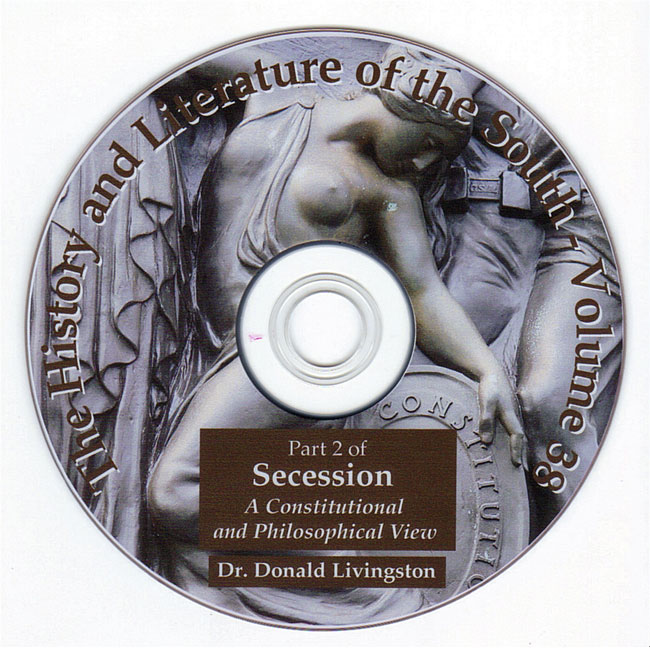
Part
2 of Secession, A Constitutional and Philosophical View
by Dr. Donald Livingston
-
Alexander Stephens and A Constitutional View
of the Late
War Between the States
by historian Joseph Stromberg of the
Ludwig von Mises Institute
-
The
Philosophical Meaning of the Confederacy
by Dr. Donald Livingston
-
The
Fourteenth Amendment, A Perverse Incentive
by Dr. Donald Livingston
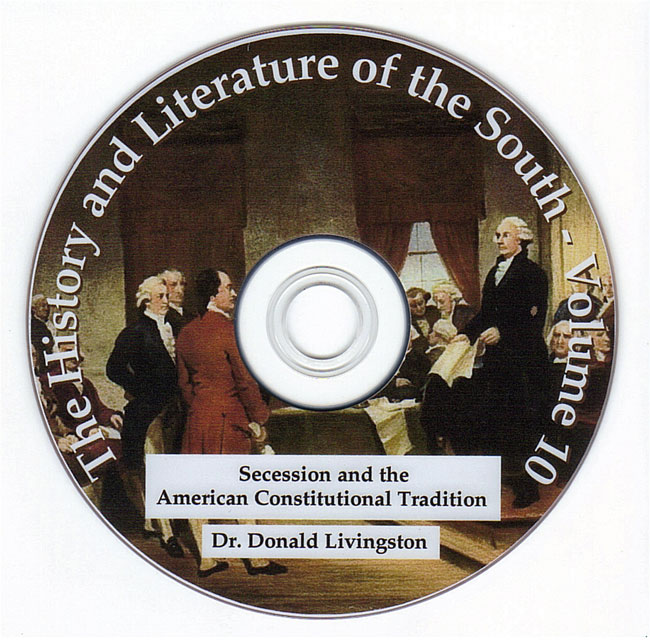
1 hour, 18 minutes
$7.95 plus shipping; scroll down to
buy set
1 hour, 13 minutes
$7.95 plus shipping; scroll down to
buy set
1 hour, 18 minutes
$7.95 plus shipping; scroll down to
buy set
1 hour, 14 minutes
$7.95 plus shipping; scroll down to
buy set
1 hour, 20 minutes
$7.95 plus shipping; scroll down to
buy set
1 hour, 19 minutes
$7.95 plus shipping; scroll down to
buy set
To purchase the set (all six
DVDs)
$44.95 plus shipping
Exposing the fraud in academia
The Ideological Use of Slavery
in American Liberalism
by
Dr. Don Livingston
Scroll down for a
10-minute video clip
1 hour, 13 minutes
$7.95 plus shipping
| |
Dr. Don
Livingston discusses the driving impulse of the 19th century,
which was
centralization, desired by Europe and the North. The
South was the only major entity on earth to resist centralization. He says it
is an absurd notion that the North invaded the South to free the
slaves. He maintains that it was an evil barbarism for the North
to invade to force the South back into a union it had voted to
secede from. He talks about the virulent racism in the North.
Most Northern
states forbid blacks from living there.
Lincoln's Illinois
had laws that stated any black person staying longer than 15 days
after notification to leave
was subject to arrest and flogging.
New England ran the slave
trade and made huge fortunes in the process. The entire
infrastructure of the Old North was built on the slave trade.
Marxism and liberalism are two sides of the same coin.
|
|
Purchase all eight of Dr. Clyde Wilson's
DVDs
$59.95 plus shipping
You get:
| |
-
Volume 3
- Part I of The War Between the States:
Its Causes and Conduct
-
Volume 4
-
Part II of
The War Between the States:
Its Causes and Conduct
-
Volume 16
- John C. Calhoun: Last of the Founding Fathers
-
Volume 18
- John C. Calhoun: Prophet
-
Volume 25
- The Causes of the Late War of Independence
-
Volume 26
- The Conduct of the Late War of Independence
-
Volume 49
- Reconstruction
-
Volume 53
- John C. Calhoun Seminar, Part 1
|
Purchase all six of Dr. Donald
Livingston's DVDs
$44.95 plus shipping
You get:
| |
-
Volume 10
- Secession and the
American Constitutional Tradition
-
Volume 20
-
The Philosophical Meaning of the Confederacy
-
Volume 33
- The Fourteenth Amendment, A Perverse Incentive
-
Volume 37
- Part 1 of
Secession: A Constitutional and Philosophical View
-
Volume 38
- Part 2 of
Secession: A Constitutional and Philosophical View
-
Volume 45
- The Ideological Use of Slavery
in American Liberalism
|
Purchase
all 24 of the above DVDs
$175.00 plus shipping
You get:
From Dr. Clyde Wilson
| |
-
Volume 3 -
Part I of The War Between the States:
Its Causes and Conduct
-
Volume 4 -
Part II of
The War Between the States:
Its Causes and Conduct
-
Volume 16 - John C. Calhoun: Last
of the Founding Fathers
-
Volume 18 - John C. Calhoun: Prophet
-
Volume 25 - The Causes of the Late War of Independence
-
Volume 26
- The Conduct of the Late War of Independence
-
Volume 49
- Reconstruction
-
Volume 53 - John C. Calhoun Seminar, Part 1
|
From Professor Edward C. Smith
| |
-
Volume 1 - Mixed Up with All the Rebel Horde,
Why Black Southerners Fought for the South
in the War Between the States
-
Volume 2 - Mixed Up with All the Rebel Horde,
Why Black Southerners Fought for the South
in the War Between the States
|
From World Class Singers and a
Pianist
| |
-
Volume 58, An Evening of Antebellum Music, Part One
-
Volume 59, An Evening of Antebellum Music, Part Two:
The Poetry and Music of John Hill Hewitt
|
From Dr. Mark Winchell
From Dr. Don Livingston
| |
-
Volume 10 - Secession and the
American Constitutional Tradition
-
Volume 20 -
The Philosophical Meaning of the Confederacy
-
Volume 33 - The Fourteenth Amendment, A Perverse Incentive
-
Volume 37 -
Part 1 of Secession: A Constitutional and Philosophical View
-
Volume 38 -
Part 2 of Secession: A Constitutional and Philosophical View
-
Volume 45 - The Ideological Use of Slavery
in American Liberalism
|
From Flannery O'Connor's good
friend, Mary Barbara Tate
From Mises Institute historian,
Joseph Stromberg
From Dr. David Aiken
An 80-DVD set
World History 101
and 102
Shot live at one
of the oldest and finest liberal arts colleges
in the country
Below are some DVDs on Europe
and the Atlantic
World relevant to Southern history.
Click here
www.WorldHistory101-102.com
or any DVD picture for
more information including video clips. DVDs feature distinguished
military historian, author, scholar and history professor
Dr. Clark G.
Reynolds

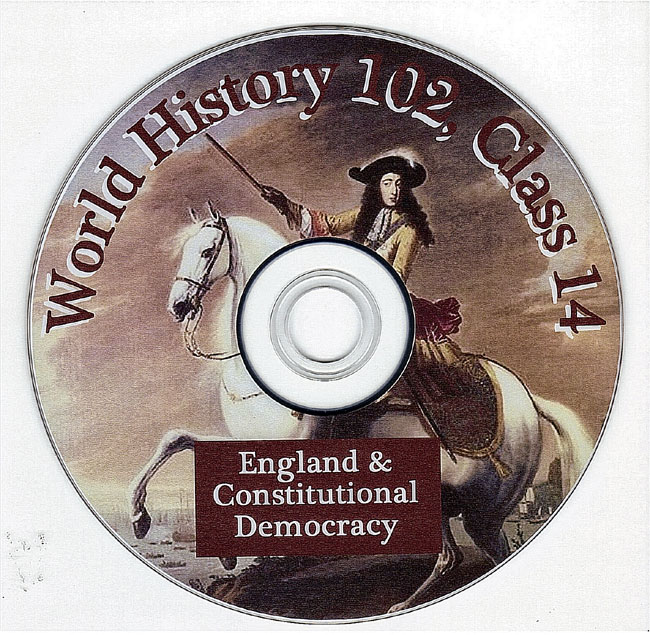

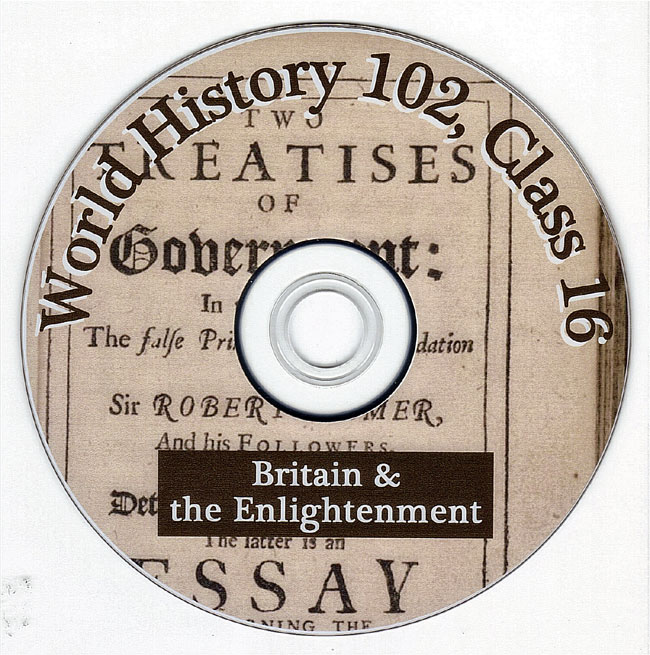

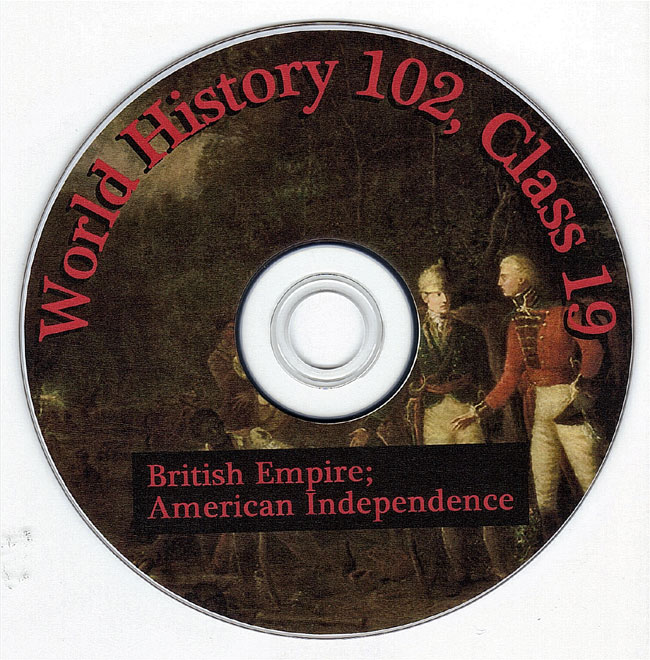


| |
Below is a video clip of Professor Reynolds
teaching his class in
World History 102, Class 34, World War II in Europe. There are
several more video clips on the
World History website.
|
|
| |
There are 80 OUTSTANDING DVDs in the
World History 101 and 102 series that were shot live in two
college classes over an entire semester in one of the oldest and
finest liberal arts colleges in the country. The set covers prehistory to 2001.
www.WorldHistory101-102.com
|
|
Click HERE or below to go to the largest
Confederate clip art and graphics gallery
on earth!

| |
Please continue scrolling down
for the essay "The Right of
Secession" and a shorter essay, "The Slavery Lie," both by Gene Kizer,
Jr., plus
primary source documents, the outstanding "A Detailed Chronology of Secession with
Bibliography," and other valuable information.
|
|
|
On certain pages including this one, music clips
from
The Rebelaires
load automatically
and play 1 to 3 times as you browse the page.
The Slavery Lie
Slavery was not the cause
of the war
Esteemed historian Eugene Genovese warned that today's
politically correct interpretations of Southern history are a "cultural and political atrocity,"
mostly because of the falsehood
that slavery was the cause of the War Between the States.
Unquestionably, slavery was not the cause of the war.
The South's economic independence from the North was.
The North could not allow its economic colony to secede and
compete against it without total economic collapse.
The collapse of the Northern economy was well underway as the
Southern states seceded. Northern states were facing bankruptcy and anarchy.
Early in the secession debate, there
was noble rhetoric from Northerners
such as Horace Greeley who wrote that the North should
let our "erring sisters go in peace."
But when he started realizing that the
North was totally dependent on the South, and the South was producing the wealth
of the nation in King Cotton, he wanted war, as did the rest of the
North.
You can not read a single Northern newspaper editor after January
of 1861 who is not petrified of the impending Northern collapse.
The short reason is that the North did not sell its manufactured
goods to the rest of the world.
It sold overwhelmingly to the South.
This was the era
of the Pax Britannica and mighty Great Britain, not the North, ruled the oceans and global
trade.
The South was the North's only significant market, and we were a
captive market, because import tariffs benefiting Northern manufacturers made
free trade impossible.
We could pay exorbitant Northern protectionist monopolistic prices because we were producing the wealth of the
nation in Southern commodities, and cotton was king.
There is no question about
this. It can not be denied. It is a proven fact of economics and history: The
South was, by far, producing the wealth of the
United States in 1860.
And - OUTRAGEOUSLY - the South was paying 3/4ths of the taxes
of the United States through tariffs, yet 3/4ths of the tax money was being spent in the North.
Robert Toombs famously called it a "suction pump" sucking wealth
out of the South and depositing it in the North.
The taxes in the Revolutionary War that prompted the Colonies to
secede from Great Britain were MINISCULE compared to the theft going on in 1860.
That, alone, was reason enough to separate from the North, and,
clearly, it was the future if the South remained in the Union.
It's what the Northern states demanded. It's what the
presidential campaign of 1860 was all about: A sectional takeover of the federal
government by the Northern States because of their larger population.
Southerners knew they would be outvoted in the U.S. House and
Senate from then on, and there was nothing they could do about it in the Union.
They had already endured years of utter hatred from the North, numerous
violations of the Constitution and Northern sponsored terrorism in John Brown.
Southern concerns were legitimate.
All the North needed was a sectional president, and they got him
in Lincoln, who did not receive a single vote south of the Mason-Dixon Line,
and, indeed, was not even on the ballot.
All the Northern hate in the campaign of 1860 was about
consolidating their vote around Lincoln so they could take over the government
and rule the country for their benefit.
Think about the passions of politics today between liberals and
conservatives, the hates and rivalries, the determination to come back to power
or stay in power, then realize it was a million times more passionate in 1860
because the North realized for the first time in American history that it could
take over the government completely and rule the country because of its larger
population.
It was a lust for power and control as stated in 1860 in The
Address of the People of South Carolina, Assembled in Convention, to the People
of the Slaveholding States of the United States: ". . . when vast sectional
interests are to be subserved, involving the appropriation of countless millions
of money, it has not been the usual experience of mankind, that words on
parchments can arrest power."
Alexis de Tocqueville had also given a dire warning that if one region
got a majority vote in the government, that region would take over and remake
the country in its own image and rule the country for its own benefit.
That was the conclusion of the greatest observer of American
democracy to ever live.
Northerners consolidated their vote, but they were ignorant of
the national economy.
Those Southerners they were hating so badly were producing the
wealth of the nation and were the North's only manufacturing customers.
Without the South to sell to, and get raw materials from,
Northern factories stood idle and the North faced massive unemployment, business
and bank failures, loss of property values and wealth, and anarchy.
It was already happening as the Southern States seceded.
The North was rushing headlong into a panic that would make the Great
Depression look like a walk in the park.
Unlike the 1930s, the North
was about to lose ALL of its manufacturing customers and tax base at one fell
swoop . . . then face those customers as strong competitors who had control of
the most demanded raw materials on earth, and had lucrative free trade
relationships with Great Britain and the rest of a world that was clamoring for
Southern cotton.
Lincoln was under enormous pressure the entire time the Southern
States were seceding. He faced the specter of going down in history as an abject
failure who led the Northern economic collapse.
He was the first sectional
president and he was about to let his section - the North -
fall into bankruptcy and anarchy.
However, he had the trump card of all tyrants: WAR.
He knew war would solve everything and give him a "magnificent burst of
patriotism" as one writer said. The Constitution be damned.
I'm sure Lincoln thought it would be short and quick and nothing
like what happened or even he might have had second thoughts before
sending a
military mission to Fort Sumter in April, 1861 knowing, full well, it would start
the war.
Lincoln's commander at Fort Sumter,
Major Robert Anderson, said clearly that Lincoln started the war.
Anderson
wrote a letter in response to Lincoln and Secretary of War Cameron's letter that
informed him of the
Fort Sumter reinforcement plans as Northern warships approached Charleston.
Anderson minced no words:
| |
. . . a movement made
now when the South has been erroneously informed that none such will be
attempted, would produce most disastrous results throughout our country. . . .
We shall strive to do our duty, though I frankly say that my heart is not in
the war which I see is to be thus commenced. . . .
|
|
The South Was Right
We were right in that conflict - not just morally, for wanting
freedom and independence, but legally.
Secession was a sacred legal right won by our forefathers of 1776
for their progeny, and every single Southern State exercised that right in the
correct manner using the same procedure the states had used to ratify the United
States Constitution.
In each Southern State, we vigorously debated secession, then we elected Unionist and
Secessionist delegates to conventions to
decide the single issue of secession.
In each Southern State, on convention floors, delegates further debated the issue,
then they voted - and the decision was the same as
July 4, 1776 - for secession and independence.
It was the most pure expression of republican government and democracy
that the world had ever seen for such a large number of people and such a huge
landmass.
It was an affirmation of the South's commitment to constitutional
government and the republic of the Founding Fathers.
Possessing the wealth of the nation in cotton, and anxious to
industrialize and trade freely with the world, the South was a rising star and
would be a formidable competitor for Lincoln and the subsidized
North, and they all knew it.
The North grossly mismanaged
its own economy
Northern greed had driven an insatiable demand for government
support from the end of the Revolution on. Unfair Northern monopolies and
protectionism benefited Northern states and penalized the rest of the country,
especially the South, which had always wanted free trade.
The Morrill Tariff of 1861, that passed the moment
Southerners seceded and were not in Congress to vote against it, was the
catalyst that brought Northern greed and mismanagement to a head. The Morrill
Tariff immediately began destroying Northern trade and the Northern economy.
The entry of goods into the North after the Morrill Tariff was
approximately 40% to 60% higher than in the South, so nobody on the planet
wanted to do business with the North.
Southerners had wisely prohibited protective tariffs in their
constitution so entry of goods into the South was a tiny fraction of the cost to
ship to the North.
Southerners were brilliant, while greedy Northerners destroyed
their own economy and made a blockade and war necessary from their standpoint.
Don't take my word
Read Northern newspaper editors anytime after January, 1861 when
most Southern states followed South Carolina's lead and seceded.
Northern newspapers were all utterly petrified about the imminent
Northern collapse and there were abundant signs that anarchy was fast
approaching.
Even Northern ship captains were leaving Northern cities and
transferring operations to Norfolk, Wilmington, Charleston, Savannah, New
Orleans and other Southern ports, while goods rotted on the docks of New York City.
When Lincoln sent an armed naval flotilla into South Carolina to
reinforce Fort Sumter on sovereign South Carolina soil, he knew - beyond the shadow of a doubt
- that he was starting a war.
All the Northern rhetoric since the end of the war has tried to
justify
the Northern destruction of the country and the 1,000,000 casualties that went
along with it by saying that the good Northern States invaded the evil South to free the slaves.
Nothing could be further from the truth, as Lincoln himself said
during the first two years of the war.
One only has to remember that five slave states fought for the
North throughout the war and NONE of their slaves were "freed" by the Emancipation Proclamation.
The Northern invasion of the South was unconstitutional and
immoral and it ranks Lincoln up there with the worst tyrants in world history.
The South was the heir of the original American Republic that
declared its independence in 1776. That's why a triumphant George Washington is
in the center of the Great Seal of the Confederacy.
It was about freedom and the rights of Southern States to govern
themselves and protect themselves from a dominating, taxing, constantly
encroaching federal government controlled by Northern bankers and business
interests.
And today, it is about the exact same thing: The rights of our
States verses the tyranny of the "one size fits all" federal government that was
empowered by the despot Lincoln and the illegal, immoral Northern victory.
The facts are all there. Educate yourself and argue well because
truth is on our side.
Deo Vindice
Gene Kizer
Publisher
Charleston, South Carolina


A Detailed,
Annotated CHRONOLOGY
of Secession,
with Bibliography
Click here for an excellent, lengthy,
annotated, narrative chronology with profuse quotations from speeches, debates
and documents that include not only the secession debate in the South, 1860-1861, but such detail as the calling of secession conventions in the different Southern states, the actual convention votes for/against secession, the dates of ratification by the people in their various states with the actual vote totals for/against, the events happening on the national level as the Confederate government is organized at the same time that Lincoln takes over as U.S. president, and all things pertaining to the beginning of the War Between the States. There is also a bibliography divided into primary and secondary sources.

Essays

Coming Soon
-
Esteemed historian Dr. Eugene D. Genovese's UNCOMPLIMENTARY assessment of modern politically correct scholarship on the South and WBTS: "We are witnessing a cultural and political atrocity..."
-
A review of Charles B. Dew's book,
Apostles of Disunion, Southern Secession Commissioners and the Causes of the Civil War (sic)
-
A summary of the excellent book,
Black Bondage in the North
-
An article on the laws of the many Northern and Western states that had FORBID free blacks from living there including Lincoln's own Illinois
-
The causes of the WBTS in articles written by Southerners who were there
-
New England's secessionist convention:
The Hartford Convention
Primary Source Documents
(Official Secession Documents, Gubernatorial Messages, Farewell Speeches, Letters and Addresses of Commissioners, General Speeches, Other Special Documents)
Official Secession Documents
(Declarations, Addresses, Resolutions and Reports that speak officially for a state or county)
-
Address of the People of South Carolina, Assembled in Convention, to the People of the Slaveholding States of the United States, adopted 24 December 1860 (includes background; author Robert Barnwell Rhett)
-
Address to the People of Texas, 30 March 1861 (includes background)
-
The Botetourt Resolutions of
Judge John J. Allen, adopted 10 December 1860 (includes background and brief biography of Judge John J. Allen, President of the Supreme Court of Virginia)
-
Declaration of Causes Which Impel the State of Texas to Secede from the Federal Union, adopted
2 February 1861
-
Declaration of Independence and Ordinance dissolving the federal relations between the State of Tennessee and the United States of America, adopted
6 May 1861
-
Declaration of the Immediate Causes Which Induce and Justify the Secession of South Carolina from the Federal Union, adopted 24 December 1860 (includes background, author Christopher Gustavus Memminger)
-
Declaration of the Immediate Causes Which Induce and Justify the Secession of Mississippi from the Federal Union, adopted
26 January 1861
-
Joint Resolution of the General Assembly of Alabama, adopted
24 February 1860 (includes background)
-
Ordinance to dissolve the union now existing between the State of Arkansas and the other states united with her under the compact entitled "The Constitution of the United States of America", adopted
6 May 1861
-
Ordinance to repeal the ratification of the Constitution of the United States of America by the State of Virginia, and to resume all the rights and powers granted under said Constitution, adopted
17 April 1861
-
Report on the Causes of the Secession of Georgia, adopted
29 January 1861 (includes background, author Robert Toombs, delivered by E.A. Nisbet)
-
Resolutions on Secession from Floyd County, Georgia, adopted November, 1860
Gubernatorial Messages
Farewell Speeches
(delivered in the Senate, and
House of Representatives of the
United States Congress)
Letters and Addresses
of Commissioners
(from one Southern state to another)
General Speeches
-
Henry L. Benning's Secessionist speech in Milledgeville, Georgia
19 November 1860 (includes biography of "Rock" Benning, for whom the U.S. Army Base in Columbus, Georgia, Fort Benning, is named)
-
Honorable Williamson R. W. Cobb of Alabama, speech delivered in the United States House of Representatives 7 January 1861 (includes brief biography of Rep. Cobb)
-
Letter from Honorable John H. Reagan, member of the United States House of Representatives from Texas, 19 October 1860 (includes biography of Rep. Reagan)
-
Opening Speech by then
temporary president of the South Carolina Secession Convention, General David F. Jamison,
17 December 1860 (includes background, biography of Gen. Jamison)
-
Speech of C. Q. Lemmonds, Esq., of Union (North Carolina) on the Convention Bill, 17 January 1861 (includes brief biography)
-
Speech of Edmund S. Dargan in the Secession Convention of Alabama,
11 January 1861 (includes brief biography)
-
Speech of United States Representative John H. Reagan of Texas,
January 15, 1861
-
Speech of William Lowndes Yancy, "The Constitution and the Union",
10 November 1860 (includes biography of William Lowndes Yancy)
-
Speech of William Lowndes Yancy, "Equal Rights in a Common Government",
21 September 1860
-
Thomas R. R. Cobb's Secessionist Speech, Milledgeville, Georgia, 12 November 1860 (includes biography of Thomas R. R. Cobb)
Other Special Documents
|
The South Carolina Sovereignty Flag, 1860
The Right of Secession
by
Gene Kizer, Jr.
(click
here for
full-page format)
There is no evidence that
secession was illegal or prohibited by the Constitution, and in fact there
is almost overwhelming evidence to the contrary, that secession was a legal,
constitutionally sanctioned act. Historian Kenneth M. Stampp, in his book The Imperiled Union, maintains that it is
impossible to say that secession was illegal because of the ambiguity of the
original Constitution as to state sovereignty and the right of secession. He
points out that "the case for state sovereignty and the constitutional right
of secession had flourished for forty years before a comparable case for a
perpetual Union had been devised," and even then its logic was "far from
perfect because the Constitution and the debates over ratification were
fraught with ambiguity."1 It appears that the original
intent
of an unquestioned right of secession was established by the Founders, took
root and "flourished for forty years," then
later a "perpetual Union" counter-argument developed out of political necessity when Northern states began realizing their
wealth and power was dependent on the Union and its exploitation of the
South.
There had to be a specific constitutional prohibition on secession for it to
be illegal. Conversely, there did not have to be a specific constitutional
affirmation of the right of secession for it to be legal. Why? Because the
10th Amendment to the United States Constitution states:
The powers not delegated to the United States by the Constitution, nor
prohibited by it to the States, are reserved to the States respectively,
or to the people.
There was no constitution prohibition on secession, nor was there a
constitutional sanctioning of any kind of federal coercion to force a state
to obey a federal law because to do so was to perpetrate an act of war on
the offending state by the other states, for whom the federal government was
their agent.
The arguments for the right of
secession are unequivocal. There is the constitutional right based on the
Compact Theory, and the revolutionary right based on the idea that a free
people have the right to change their government anytime they see fit. The
Compact Theory views the Constitution as a legal agreement between the
states - a compact - and if any one state violates the compact, then the
entire agreement becomes null and void. Northern states unquestionably
violated the Constitution on a number of grounds including unconstitutional
Personal Liberty Laws on their books, as well as by deliberately harboring
fugitives from justice by protecting the sons of John Brown who were wanted
by Virginia for murder at Harpers Ferry. Northern states also made a mockery
of the Constitution's Preamble, which states clearly that the Constitution
was established to "insure domestic Tranquility" and "promote the general
Welfare." Certain prominent Northern leaders with the acquiescence of states
like Massachusetts were utterly at war with the South and doing everything
they could to destroy the domestic tranquility of Southern states by
encouraging slaves to murder white people, poison wells, destroy property
and commit other acts of rapine. John Brown himself had been encouraged and
financed in the North.
The revolutionary right of secession is
based on the Declaration of Independence and the philosophy of Thomas
Jefferson and John Locke, that
whenever any form of government becomes
destructive of the ends for which it was established, it is the right of
the people to alter or abolish it, and to institute new government, . . .
These words come directly from the Declaration of Independence.
This passage was also used, verbatim, in South Carolina's Declaration of
the Immediate Causes Which Induce and Justify the Secession of South
Carolina from the Federal Union. A similar sentiment was expressed by
Abraham Lincoln in 1847 on the floor of the United States House of
Representatives:
Any people, anywhere, being inclined and having the power, have the
right to rise up and shake off the existing government, and form a new one
that suits them better. This is a most valuable, a most sacred right, a
right which we hope and believe is to liberate the world.2
Horace Greeley's New York Daily Tribune published a long, emotional editorial on December 17, 1860, the day South Carolina's Secession
Convention began, strongly supporting the right of secession on the
revolutionary basis. The Tribune used the exact same passage used in
South Carolina's Declaration of Immediate Causes, which comes from the
Declaration of Independence, reiterating that the "just powers" of
government come from the "consent of the governed" and "'whenever any form
of government becomes destructive of these ends, it is the right of the
people to alter or abolish it, and institute a new government,' &c., &c.",
adding that
We do heartily accept this doctrine, believing it intrinsically sound,
beneficent, and one that, universally accepted, is calculated to prevent
the shedding of seas of human blood. And, if it justified the secession
from the British Empire of Three Millions of colonists in 1776, we do not
see why it would not justify the secession of Five Millions of Southrons
from the Federal Union in 1861.3
The Tribune goes on to say it "could not stand up for coercion,
for subjugation," because "We hold the right of self-government sacred," and
if the Southern States want out, "we shall feel constrained by our devotion
to Human Liberty to say, Let Them Go!", because self-government is one of
the "Rights of Man."4
The States' Rights Hartford
Convention of New England, aggrieved by the financial losses of New
Englanders in shipping during the War of 1812, met in 1815 and seriously
discussed seceding from the Union. The Convention selected representatives
to go to Washington to present its grievances to the government. It even
chose a military leader should its grievances be
ignored, and made arrangements for a second convention, if necessary, to
make specific plans to secede. Commissioners were sent to Washington but
upon arriving found that the War of 1812 had ended, therefore it was not
necessary to air their grievances. The Journal of the Hartford Convention
bristles with references to state sovereignty, and uses States' Rights language such as the right of a state to decide for
itself when a violation of the Constitution occurred. One quote from the
Hartford Convention Journal, justifying secession, sums it up:
Whenever it shall appear that these causes are radical and permanent, a
separation by equitable arrangement, will be preferable to an alliance by
constraint, among nominal friends, but real enemies, inflamed by mutual
hatred and jealousy, and inviting by intestine division, contempt and
aggression from abroad.5
Some excellent constitutional arguments are summarized in an article
entitled "The Foundations and Meaning of Secession," by Mr. H. Newcomb
Morse, in the Stetson Law Review, a publication of the
Stetson University College of Law.6 Morse writes that the War
Between the States did not prove that secession was illegal because
many incidents both preceding and following the War support the
proposition that the Southern States did have the right to secede from the
Union. Instances of nullification prior to the War Between the States,
contingencies under which certain states acceded to the Union, and the
fact that the Southern States were made to surrender the right to
secession all affirm the existence of a right to secede . . .7
He adds that the Constitution's "failure to forbid secession" and
amendments dealing with secession that were proposed in Congress as Southern
states were seceding strengthened his argument that "the Southern States had
an absolute right to secede from the Union prior to the War Between the
States."8
Morse argues that because the Constitution did not forbid
secession, then every state acceding to the Constitution had the implied
right to secede from it. He says that if men of the caliber of Madison,
Hamilton, Wilson and the others meant to forbid secession they definitely
would have said so, and the omission of a prohibition on secession in the
Constitution is strong proof that the right of secession existed and was
assumed. He quotes James Madison from The Madison Papers who wrote
"a breach of any one article by any one party, leaves all other parties at
liberty to consider the whole convention as dissolved."9 Vermont
and Massachusetts, he points out, nullified with statutes, the Fugitive
Slave Law of 1793, and those two breaches of the compact alone were enough
for the South to consider the compact dissolved.
There were many other violations of
the Constitution discussed throughout the secession debate including Northern Personal Liberty Laws
that, in
effect, nullified the Fugitive Slave Law of the Compromise of 1850 as well
as Article IV, Section 3 of the Constitution, which dealt with fugitive
slaves. At least ten Northern states had statutes that nullified the two
aforementioned laws.
Other breaches of the Constitution included, as stated earlier, the harboring of fugitives from
justice in the North, specifically two of John Brown's sons who were with
Brown at Harpers Ferry and were wanted in Virginia for murder, but were being harbored in Ohio and Iowa.
Brown himself had been encouraged by Northerners and financed by Northern
money. Certain Northern leaders, again, with the acquiescence of states like
Massachusetts, tried desperately to destroy "domestic Tranquility"
in the South by sending incendiary abolitionist material in the
mail encouraging slaves to revolt and murder. Lincoln's own Republican Party
published 100,000 copies of Hinton
Helper's The Impending Crisis, which called for slave revolt, and
Republicans in Congress endorsed the book and used it as a campaign tool.
To prove the right of a state to determine for itself when the
Constitution has been violated, Morse quotes Jefferson's Kentucky
Resolutions which point out that if the government had the right to
determine when the Constitution was violated, then the government would be
the arbiter of its own power and not the Constitution. The Kentucky
Resolutions also reaffirm state sovereignty and independence.10
Morse demonstrates that congressional discussions and proposed
legislation during the secession of Southern states indicated that Congress
believed the right of secession to exist. One piece of legislation was introduced to deal
with the disposition of federal property within a seceding state, as well as
a seceding state's assumption of its share of the national debt. Another
scrambled to forbid secession unless approved by two-thirds of the members
of both Houses of Congress, the president, as well as all the states. Morse
then points out that thirty-six years earlier, Chief Justice John Marshall,
in Gibbons v. Ogden wrote that "limitations of a power furnish a
strong argument in favor of the existence of that power. . . .11
He concludes:
What would have been the point of the foregoing proposed amendments to
the Constitution of the United States prohibiting or limiting the right of
secession if under the Constitution the unfettered right of secession did
not already exist? Why would Congress have even considered proposed
amendments to the Constitution forbidding or restricting the right of
secession if any such right was already prohibited, limited or
non-existent under the Constitution?12
Morse goes on to discuss the conditional ratification of the Constitution
by three of the original thirteen states, which carefully reserved the right
of secession. They were Virginia, New York, and Rhode Island. Virginia used
the exact wording of her conditional ratification of the U.S. Constitution,
in her Ordinance of Secession. Morse points out that since the other states,
which had unconditionally ratified the Constitution, consented to Virginia's
conditional ratification, then they "ostensibly assented to the principle
that Virginia permissibly retained the right to secede." He adds that with
the additional acceptance of "New York's and Rhode Island's right to secede,
the existing states of the Union must have tacitly accepted the doctrine of
secession." Further, Morse states that according to the Constitution, all
the new states that joined the Union after the first thirteen also had the
right of secession since new states entered on an equal footing with the
exact same rights as the existing states.13
Southerners during the secession debate knew and understood this
argument. Senator Judah P. Benjamin of Louisiana, a brilliant legal mind who
was later Attorney General, Secretary of War and Secretary of State of the
Confederacy, in his farewell speech to the United States Senate on February
5, 1861, said:
The rights of Louisiana as a sovereign state are those of Virginia; no
more, no less. Let those who deny her right to resume delegated powers,
successfully refute the claim of Virginia to the same right, in spite of
her expressed reservation made and notified to her sister states when she
consented to enter the Union.14
Morse skips forward to Reconstruction, and points out that "the Northern
occupational armies were removed from Arkansas, North Carolina, Florida,
South Carolina, Mississippi, and Virginia only after those former
Confederate States had incorporated in their constitutions a clause
surrendering the right to secede." Morse then argues brilliantly that
by insisting that the former Confederate States surrender their right
to secede, the United States government had implicitly admitted that those
states originally had the right. How could they surrender a right, unless
they had it in the first place?15
To summarize, Morse points out that before the war, under Virginia's
conditional ratification of the Constitution, when the people decided that
government power had been "perverted to their injury or oppression," they
had the right to secede. When Northern states passed Personal Liberty Bills
and other statutes nullifying the fugitive slave laws of the Constitution
(Article IV, Section 3), a "perversion" occurred which gave the Southern
states the right to secede. Reinforcing that "perversion" even further was
the Federal government's not forcing those Northern states to abide by the
Constitution, therefore
the Northern States conceivably "perverted" national law to the "injury
or oppression" of the people of the Southern States. Thus, the
reassumption of the powers of government by the people of the Southern
States was a natural consequence of the Northern States' conduct and the
federal government's failure to prohibit that conduct.16
The only other issue, according to Morse, was whether the Southern states
conducted their act of secession legally. Morse points out that the people
are the sovereign, having supreme, absolute and perpetual power, therefore
secession would have to be accomplished by the people of each state rather
than even the legislatures. He says "convention delegates elected by the
people of the state to decide one question constitute authority closer to
the seat of the sovereign -- the people themselves," therefore a convention
in each Southern state would be necessary as a "special agent of the people
of the state." Did the Southern states conduct themselves legally and
therefore perfect their acts of secession and independence? Morse says:
When the Southern States seceded from the Union in 1860 and 1861, not
one state was remiss in discharging this legal obligation. Every seceding
state properly utilized the convention process, rather than a legislative
means, to secede. Therefore, not only did the Southern States possess the
right to secede from the Union, they exercised that right in the correct
manner.17
Morse's conclusion is that "conceivably, it was the Northern States that
acted illegally in precipitating the War Between the States. The Southern
States, in all likelihood, were exercising a perfectly legitimate right in
seceding from the Union."18
Other evidence of the right of secession abounds. Albert Taylor Bledsoe wrote in 1866 what is
thought to be the best book ever written on the right of secession: Is
Davis a Traitor; or Was Secession a Constitutional Right Previous to the War
of 1861? Dr. Richard M. Weaver, who was, during his lifetime, a
professor and author of several noted books on the South, called Is Davis
a Traitor? "the masterpiece of the Southern apologias." Weaver described
it as a "brilliant specimen of the polemic" out of the entire "extensive
body of Southern political writing."19
Dr. Clyde N. Wilson, long time professor of history at the University of
South Carolina, goes even further. In the Introduction to a 1995 reprint of
Is Davis a Traitor?, Dr. Wilson lists the top seven books defending
the South and the right of secession and says "Bledsoe did it first and
best," his argument for the right of secession
being "absolutely irrefutable to any honest mind."20 The other
six works that best defend the South and right of secession according to Dr.
Wilson are the two-volume work A Constitutional View of the Late War
Between the States by Alexander H. Stephens, The Rise and Fall of the
Confederate Government by Jefferson Davis, A Defence of Virginia and
Through Her of the South by Robert L. Dabney, The Creed of the Old
South by Basil L. Gildersleeve, The Southern States of the American
Union Considered in their Relations to the Constitution of the United States
and the Resulting Union by Jabez L. M. Curry, and The Lost Cause
by Edward A. Pollard.
According to Dr. Wilson in the Introduction, pages i-viii, Bledsoe was
born in Frankfort, Kentucky, in 1809. He graduated from West Point in 1830
and had been there part of the time with Robert E. Lee, Jefferson Davis,
Leonidas Polk and Albert Sydney Johnston. He loved mathematics and theology,
but practiced law for nine years in Springfield, Illinois, as part of a bar
that included Abraham Lincoln and Stephen A. Douglas. Dr. Wilson writes that
"it was said that Bledsoe won six out of eleven cases tried against
Lincoln," and that he had given Lincoln lessons, at one point, on using a
broadsword because Lincoln had been challenged to a duel. After his legal
career, Bledsoe taught astronomy and mathematics at the University of
Mississippi, acquiring a "legendary" genius for mathematics. In 1854, he
began teaching mathematics at the University of Virginia. During the war,
Bledsoe served briefly as the colonel of a regiment of infantry from
Virginia, then later in the Confederate War Department, and finally he was
sent to Europe by President Davis on what is thought to have been a secret
diplomatic mission to influence public opinion in Britain. After the war,
until his death in 1877, Bledsoe published The Southern Review, in
which he continued to argue the justice and truth of the Southern cause.
Bledsoe began working on Is Davis a Traitor? while in England and
published it just after the war "as a part of the campaign of Davis's
defense." The Confederate President was in a Yankee prison, Fortress Monroe,
where he spent a miserable two years waiting to be tried for treason. He was
in irons with a light shining brightly in his cell twenty-four hours a day
and with Union guards marching back and forth. The bright light was an
additional measure of Yankee viciousness since it was known that Davis had
never been able to sleep except in total darkness.
Davis wanted to be tried for treason because he was confident he could
prove the right of secession. However, he never got his chance, and that
denial of Jefferson Davis' trial on the charge of treason by the Northern
government is additional evidence of the right of secession.
In talking about the effectiveness of
Is Davis a Traitor?,
Richard Weaver writes that
Bledsoe witnessed some practical result of his labor when Robert Oulds
and Charles O'Conor, attorneys for Jefferson Davis, made use of the book
in preparing their defense; but the Federal government, apparently feeling
the weakness of its legal position, allowed the case to be dismissed.21
Here was the North's big chance to prove the South wrong once and for
all in a solemn, dignified court of law in the eyes of the entire world
and for all of posterity, but they refused to take it. Why? They certainly
had not suddenly had a change of heart toward the South. It was
Reconstruction, the body of the assassinated Lincoln was barely cold in the
ground while the hateful Charles Sumner, no doubt still smarting from his
caning by Preston Brooks, along with Thaddeas Stephens and other South
hating radical Republicans were ascending in Congress. Northern troops were
in control of every Southern government while large numbers of former
Confederates were disfranchised. This was exactly the time the federal
government would have wanted to convict the Southern president if it had a
case. The federal government was willing to kill hundreds of thousands of
Southerners on the battle field, so there can be no doubt it would have
relished humiliating Jefferson Davis in a courtroom. It is a virtual
certainty that if the North's case had been strong they would have taken it
to trial and vindicated their war against the hated South once and for all.
That the Federal government did not go to court against the Confederate
president after keeping him in jail for two years charged with treason, is strong evidence that there was indeed a legal right of
secession and the South had exercised it properly. There were no other
treason trials against former Confederates because any one trial would
likely prove the legal right of secession, and imminently practical
Northerners were not about to lose in a court of law what they had won on
the battlefield.
Bledsoe's "irrefutable" argument in Is Davis a Traitor?" begins
with the Constitution as a compact, or legal agreement among the members to
the compact. The reason Bledsoe starts here is because any member that has
acceded to (agreed to) the terms of a compact, can secede from that compact
if the terms are broken by one of the other members. Bledsoe produces the
writings and statements of the strongest opponents of the Constitution as
compact - Daniel Webster and others - who have admitted that if the
Constitution is a compact, then states can secede from it; but who deny that
the Constitution is a compact.22 Webster was the great spokesman
for the North with the credibility and reputation to go along with it.
Bledsoe writes:
Thus, the great controversy is narrowed down to the single question --
Is the Constitution a compact between the States? If so, then the right of
secession is conceded, even by its most powerful and determined opponents;
by the great jurist, as well as by 'the great expounder' (Webster) of the
North.23
The evidence that the North had broken the specific terms and spirit of
the compact if it was a "compact," was substantial. As stated
earlier, Northern states had
statutes on their books nullifying the Constitutional and Congressional law
with regard to fugitive slaves. Many other specific breaches of the
Constitution by the North existed in areas besides slavery. Many in the
North for over two decades believed, as Seward had clearly stated, that they
were operating according to a "higher law" than the Constitution. The more
radical had long called the Constitution a "covenant with death and
agreement with hell."24 So, the North's having broken the compact,
virtually guaranteed that secession was legal if, indeed, the Constitution
was a compact that was "acceded to" by the original makers. Did the original
states "accede" to a compact?
Bledsoe attacks the arguments of Webster and the others one at a time
taking on the strongest, most salient parts of their arguments. For example,
Webster had said "words are things, and things of mighty influence."25
At one point, in the Senate, Webster had railed against the Constitution as
compact. Webster had said that saying "the States acceded to the
Constitution" was "unconstitutional language."26 Of course the
reason he felt that way, as Bledsoe had said, was because if states had acceded to the
Constitution, then it was only logical that they could secede from it.
Discrediting the single word, "accede," was very important to Webster, so
Bledsoe researched in great detail the words of the founders and finds that
in the Constitutional Convention of 1787, "Mr. James Wilson . . . preferred
'a partial union' of the States, 'with a door open for the accession of the
rest.'" However, "Mr. Gerry, a delegate from Massachusetts, was opposed to
'a partial confederacy, leaving other States to accede or not to accede, as
had been intimated.'" Father of the Constitution, James Madison, "used the
expression 'to accede' in the Convention of 1787, in order to denote the act
of adopting 'the new form of government by the States.'" Virginia Governor
Randolph, also at the Convention of 1787, had said "That the accession of
eight States reduced our deliberations to the single question of Union or no
Union." Patrick Henry had said that if the Constitution "be amended, every
State will accede to it." Mr. Grayson asks if Virginia will gain anything
from her prominent position "by acceding to that paper." Benjamin Franklin,
whom Bledsoe says was next in importance at the Constitutional Convention to
Washington, later said "Our new Constitution is now established with eleven
States, and the accession of a twelfth is soon expected." George Washington,
as he watched states join the Constitution, said "If these, with the States
eastward and northward of us, should accede to the Federal government . .
.". Chief Justice John Marshall used the word "accede" in reference to
joining the Constitution, and even Mr. Justice Story, a staunch opponent of
the belief in Constitution as compact, in agreement with Webster, said "The
Constitution has been ratified by all the States; . . . Rhode Island did not
accede to it, until more than a year after it had been in operation;".27
Webster had attacked the word "accede" as something invented by
proponents of the Constitution as compact. His intention was to discredit
his opponents by discrediting the language they were using, but his plan
backfired. Bledsoe points out that Webster's attack on the word "accede" by
calling it a "new word," was ill founded and incorrect because "accede" had
precisely been "the word of the fathers of the Constitution" with Washington
"at their head." They had all used the word "accede" in reference to states
joining the Constitution, and of course, the converse of the word "accede,"
is "secede."28
Over and over Bledsoe demolishes each and every argument that maintains
secession was not legal or a right. To those like Webster, who tried to say
the Constitution was not a compact, Bledsoe offers the words of the Father
of the Constitution, James Madison, in the Virginia Resolutions of 1798,
"That this assembly doth explicitly and peremptorily declare, that it views
the powers of the Federal Government as resulting from the compact, to which
the States are parties." Bledsoe further mentions a letter from Madison to a
Mr. Everett in 1830 in which Madison says that the Constitution is "'a
compact among the States in their highest sovereign capacity.'" Bledsoe then
uses Webster's own words against him, quoting Webster admitting that the
Constitution was a compact in a debate three years earlier, on "Foote's
resolutions."29 Bledsoe says:
that Mr. Webster himself, had, like everyone else, spoken of the
Constitution as a compact, as a bargain which was obligatory on the
parties to it. "it is the original bargain," says he, in that debate; "the
compact -- let it stand; let the advantage of it be fully enjoyed. The
Union itself is too full of benefits to be hazarded in propositions for
changing its original basis. I go for the Constitution as it is, and for
the Union as it is."30
Perhaps the strongest argument against the right of secession, is based
on the wording in the Constitution's Preamble: "We the people." Those who
argue that the Constitution is not a compact, but is a national document,
believe that "We the People" means all of the
American people in one body, and not in their sovereign states. This, says
Bledsoe on page 61, "is the great stronghold, if it has one, of the Northern
theory of the Constitution. The argument from these words appears in every
speech, book, pamphlet, and discussion by every advocate of the North. It
was wielded by Mr. Webster in his great debate with Mr. Calhoun, in 1833, .
. .". If the Constitution was written as a document for all of the American
people in one body, then individual states had no right to withdraw
from it. The committee on style of the Constitutional Convention of 1787 was
headed by Gouverneur Morris of Pennsylvania. Notwithstanding the Northern
nationalist rhetoric, this is what Gouverneur Morris said was the meaning of
the Constitution and those words, "We the people," that he had authored:
The Constitution was a compact not between individuals, but between
political societies, the people, not of America, but of the United States,
each enjoying sovereign power and of course equal rights.31
The "United States" means just that: states that are
united.
Morris himself believed in the right of secession and supported New
England's move to secede during the War of 1812, which culminated in the
Hartford Convention.32 Bledsoe quotes The Madison Papers
and refers to some 900 pages of the proceedings of the Constitutional
Convention of 1787 in which are recorded the debate over method of
ratification. He points out that nowhere in that vast record is there a
discussion of the "people" as meaning the entire American people outside of
their states. The big debate was over whether the legislatures of each state
would ratify the Constitution, or the "people" of each state in special
convention. It was clearly "legislature vs people in convention" of each
state. It was decided by the Constitutional Convention that since a later
legislature might rescind the ratification of an earlier legislature, it
would be a more sound foundation to have the people of each state ratify the
Constitution in special conventions called for the purpose of ratification.33
This is exactly how the South seceded, by secession conventions called
for the single purpose of deciding the issue of secession. And, as Mr. H.
Newcomb Morse said in the Stetson Law Review, "not one state was
remiss in discharging this legal obligation."
There was another problem in that nobody knew how many states, or which
ones, would ratify the Constitution, therefore listing the specific states
in the Preamble could not be done as it had been done in the body of the
Articles of Confederation. If all the states had been listed and one refused
to ratify, then the document would be invalid. The number "nine" was decided
on, as the number of states necessary to put the Constitution into effect,
but in debating the issue it was brought up that the Constitution could
only apply to those states ratifying it, therefore no references could be
made to "all" of the American people. Bledsoe writes that Rufus King
suggested adding "between the said states, so as to confine the operation of
the government to the States ratifying the same."34 The words
were cleaned up and found their way into the Constitution in Article VII
which starts out:
The Ratification of the Conventions of nine States, shall be sufficient
for the Establishment of this Constitution between the States so ratifying
the Same.
Bledsoe further clarifies by writing that "when it was determined that
the Constitution should be ratified by 'the Conventions of the States,' and
not by the legislatures, this was exactly equivalent, in the uniform
language of the Convention of 1787, to saying that it shall be ratified by
'the people of the States.' Hence, the most ardent friend of State rights,
or State sovereignty, saw no reason why he should object to the words, 'We,
the people of the United States,' because he knew they were only intended to
express the mode of ratification by the States . . . in their sovereign
capacity, as so many political societies or peoples, as distinguished from
their legislatures."35
Bledsoe goes on by pointing out that the Federal government had no legal
right whatsoever to coerce a state into following its laws therefore it had
no right to force a seceding state back into the Union. President Buchanan
had stated in his lame duck period between Lincoln's election of November 6,
1860, and March 4, 1861, when Lincoln would be inaugurated, while state
after state was seceding, that as president of the United States he had no
power to coerce a state even though he denied that secession was legal.
Bledsoe notes the contradiction in Buchanan's position and writes "if we
say, that coercion is a constitutional wrong, or usurpation, is not this
saying that the Constitution permits secession, or, in other words, that it
is a Constitutional right?" He says "Coercion is unconstitutional . . .
wrong . . .strikes down and demolishes the great fundamental principle of
the Declaration of Independence, -- the sacred right of self-government
itself." About secession, he says "Secession, on the other hand, asserts the
right of self-government for every free, sovereign, and independent State in
existence."36
Bledsoe discussed the views of credible foreigner observers and writes
that Alexis de Tocqueville, in Democracy in America, said:
The Union was formed by the voluntary agreement of the States; and in
uniting together they have not forfeited their nationality, nor have they
been reduced to the condition of one and the same people. If one of the
States choose to withdraw from the compact, it would be difficult to
disprove its right of doing so, and the Federal Government would have no
means of maintaining its claims directly either by force or right.37
To Tocqueville, Bledsoe adds "Mackay, and Spence, and Brougham, and
Cantu, and Heeren," then he goes on "as well as other philosophers, jurists
and historians among the most enlightened portions of Europe, (who) so
readily adopt the Southern view of the Constitution, and pronounce the
American Union as a confederation of States."38
Bledsoe continues with more persuasive argument, the words of Thomas
Jefferson and Alexander Hamilton, who assert, beyond doubt, that the
Constitution is a compact and the states, sovereign. He discusses William
Rawl of Philadelphia and his book, A View of the Constitution of the
United States, which stresses the right of secession and was used at
West Point during most of the antebellum era, and the State's Rights
Hartford Convention of New England states, which strongly supported the
right of secession. These are but a few of the arguments found in Bledsoe's
persuasive book.
The Southern states did not rush headlong into secession. They had
enormous grievances against the North that were much greater than even
Northern violations of the Constitution. The unfairness of taxation, which
had been the huge issue of the Revolution, was worse for the antebellum
South because three-fourths of the taxes were paid by the South, while
three-fourths of the tax money was spent in the North. It had held down the
development of Southern industry for a half-century and Southerners were
tired of it. Southerners felt the North was already at war with them in many
ways. They saw Northern emissaries sent South to encourage slave uprisings,
murder and rapine, then being applauded in the North for their grisly
successes, especially John Brown. Southerners saw Hinton Helper's book,
The Impending Crisis, which was full of errors on its economics, call
for bloody slave revolt yet be enthusiastically adopted by the Republicans
in Congress as a campaign document. With the election of Republican Lincoln,
Southerners believed those same Republicans would now put into effect the
principles of Helper's book, and there was nothing they could do about it.
For their own safety, Southern states began debating secession. They did so
peacefully and with great intellectual vigor and in the end, the people of
the South struck for independence and self-government, just as their fathers
in the Revolution had.
The North, however, had become
wealthy manufacturing, shipping, and financing for the captive Southern
market, which was rich itself because of King Cotton. The North could not
let the South go without a complete economic collapse that was well underway during the secession winter and spring of
1860-1861. All the noble rhetoric of the Horace Greeleys in 1860 about the
"just powers" of the government coming from the "consent of the governed"
was cast aside due to the specter of economic collapse and financial ruin,
thus the war came.
Notes
1Kenneth M. Stampp, The Imperiled Union,
Essays on the Background of the Civil War (New York: Oxford University
Press, 1980), 35-36.
2Abraham Lincoln, 1847 Congressional debate in
the United States House of Representatives in John Shipley Tilley,
Lincoln Takes Command (Nashville: Bill Coats, Ltd., 1991), xv. Tilley's
source, as stated in footnote #4 on page xv, was Goldwyn Smith, The
United States: an Outline of Political History, 1492-1871 (New York and
London, 1893), 248.
3"The Right of Secession," The New-York Daily
Tribune, December 17, 1860, in Howard Cecil Perkins, ed., Northern
Editorials on Secession (Gloucester, MA: Peter Smith, 1964), 199-201.
4"The Right of Secession," The New-York Daily
Tribune, December 17, 1860, in Howard Cecil Perkins, ed., Northern
Editorials on Secession, 199-201. Here is the entire editorial:
We have repeatedly asked those who dissent from our view of this matter
to tell us frankly whether they do or do not assent to Mr. Jefferson's
statement in the Declaration of Independence that governments "derive
their just powers from the consent of the governed; and that, whenever any
form of government becomes destructive of these ends, it is the right of
the people to alter or abolish it, and to institute a new government,"
&c., &c. We do heartily accept this doctrine, believing it intrinsically
sound, beneficent, and one that, universally accepted, is calculated to
prevent the shedding of seas of human blood. And, if it justified the
secession from the British Empire of Three Millions of colonists in 1776,
we do not see why it would not justify the secession of Five Millions of
Southrons from the Federal Union in 1861. If we are mistaken on this
point, why does not some one attempt to show wherein and why? . . . --we
could not stand up for coercion, for subjugation, for we do not think it
would be just. We hold the right of Self-government sacred, even when
invoked in behalf of those who deny it to others . . . if ever 'seven or
eight States' send agents to Washington to say 'We want to get out of the
Union,' we shall feel constrained by our devotion to Human Liberty to say,
Let Them Go! And we do not see how we could take the other side without
coming in direct conflict with those Rights of Man which we hold paramount
to all political arrangements, however convenient and advantageous.
5Journal of the Hartford Convention, as
quoted in George M. Curtis, III, and James J. Thompson, Jr., eds., The
Southern Essays of Richard M. Weaver (Indianapolis: LibertyPress, 1987),
153.
6Stetson University, in DeLand, Florida, was
founded in 1883, and is Florida's first university. Stetson's College of
Law, founded in 1900, is Florida's oldest law school.
7H. Newcomb Morse, "The Foundations and Meaning of
Secession," Stetson University College of Law, Stetson Law Review,
Vol. XV, No. 2, 1986), 420.
8Morse, "The Foundations and Meaning of
Secession," Stetson Law Review, Vol. XV, No. 2, 1986, 420.
9James Madison, 2 The Madison Papers
(Philadelphia: 1840), 895, in H. Newcomb Morse, "The Foundations and Meaning
of Secession," Stetson University College of Law, Stetson Law Review,
Vol. XV, No. 2, 1986), 426.
10H. Newcomb Morse, "The Foundations and Meaning
of Secession," Stetson University College of Law, Stetson Law Review,
Vol. XV, No. 2, 1986), 422-427.
11Chief Justice John Marshall, Gibbons v. Ogden,
22 U.S. (9 Wheat.) 1 (1824), 200, in H. Newcomb Morse, "The Foundations and
Meaning of Secession," Stetson University College of Law, Stetson Law
Review, Vol. XV, No. 2, 1986), 428.
12H. Newcomb Morse, "The Foundations and Meaning
of Secession," Stetson University College of Law, Stetson Law Review,
Vol. XV, No. 2, 1986), 428.
13H. Newcomb Morse, "The Foundations and Meaning
of Secession," Stetson University College of Law, Stetson Law Review,
Vol. XV, No. 2, 1986), 428-432.
14Judah P. Benjamin, "Farewell Address to the U.
S. Senate," delivered February 5, 1861, in Edwin Anderson Alderman, and Joel
Chandler Harris, eds., Library of Southern Literature (Atlanta: The
Martin and Hoyt Company, 1907), Volume I, 318.
15H. Newcomb Morse, "The Foundations and Meaning
of Secession," Stetson University College of Law, Stetson Law Review,
Vol. XV, No. 2, 1986), 433.
16H. Newcomb Morse, "The Foundations and Meaning
of Secession," Stetson University College of Law, Stetson Law Review,
Vol. XV, No. 2, 1986), 433-434.
17H. Newcomb Morse, "The Foundations and Meaning
of Secession," Stetson University College of Law, Stetson Law Review,
Vol. XV, No. 2, 1986), 434-436.
18H. Newcomb Morse, "The Foundations and Meaning
of Secession," Stetson University College of Law, Stetson Law Review,
Vol. XV, No. 2, 1986), 436.
19George M. Curtis, III, and James J. Thompson,
Jr., eds., The Southern Essays of Richard M. Weaver (Indianapolis:
LibertyPress, 1987), 152. Richard M. Weaver graduated from the University of
Kentucky in 1932, earned an M.A. degree at Vanderbilt University, and a
doctorate in English from Louisiana State University in 1943. He taught at
the University of Chicago until his death in 1963. He wrote scores of essays
and published several books. He is best known for his books Ideas Have
Consequences, and The Ethics of Rhetoric.
20Albert Taylor Bledsoe, Is Davis a Traitor; or
Was Secession a Constitutional Right Previous to the War of 1861?
(Baltimore: Innes & Company, 1866; reprint, North Charleston: Fletcher and
Fletcher Publishing, 1995), i-ii. Dr. Clyde N. Wilson is a world renowned
scholar of John C. Calhoun, having edited most of Calhoun's voluminous
papers. He has written several books, and numerous articles and essays on
Southern history.
21Curtis and Thompson, eds., The Southern
Essays of Richard Weaver, 153-154.
22Taking on Webster also challenges most of the
others who did not believe the Constitution was a compact, because most of
the others quoted Webster and used his argument.
23Bledsoe, Is Davis a Traitor?, 6.
24Bledsoe, Is Davis a Traitor?, 151-153.
25Bledsoe, Is Davis a Traitor?, 16.
26Bledsoe, Is Davis a Traitor?, 12.
27Bledsoe, Is Davis a Traitor?, 12-17.
28Bledsoe, Is Davis a Traitor?, 17.
29Bledsoe, Is Davis a Traitor?, 25.
30Bledsoe, Is Davis a Traitor?, 25.
31Gouverneur Morris, Life and Writings,
vol. iii., p. 193, as quoted in Bledsoe, Is Davis a Traitor?, 65.
32Bledsoe, Is Davis a Traitor?, 64-65;
Yanak and Cornelison, The Great American History Fact-Finder, 278.
33Bledsoe, Is Davis a Traitor?, 66-73.
34Bledsoe, Is Davis a Traitor?, 72.
35Bledsoe, Is Davis a Traitor?, 73.
36Bledsoe, Is Davis a Traitor?, 154.
37Alexis de Tocqueville, Democracy in America,
as quoted in Bledsoe, Is Davis a Traitor?, 155. The reference to
Democracy in America footnoted by Bledsoe is Vol. i, Chap. xviii., p
413.
38Bledsoe, Is Davis a Traitor?, 157.
|